Fire Hydrant Services in Miami-Dade: Inspections, Repairs, Replacement, and Installation for Commercial and Multifamily Properties
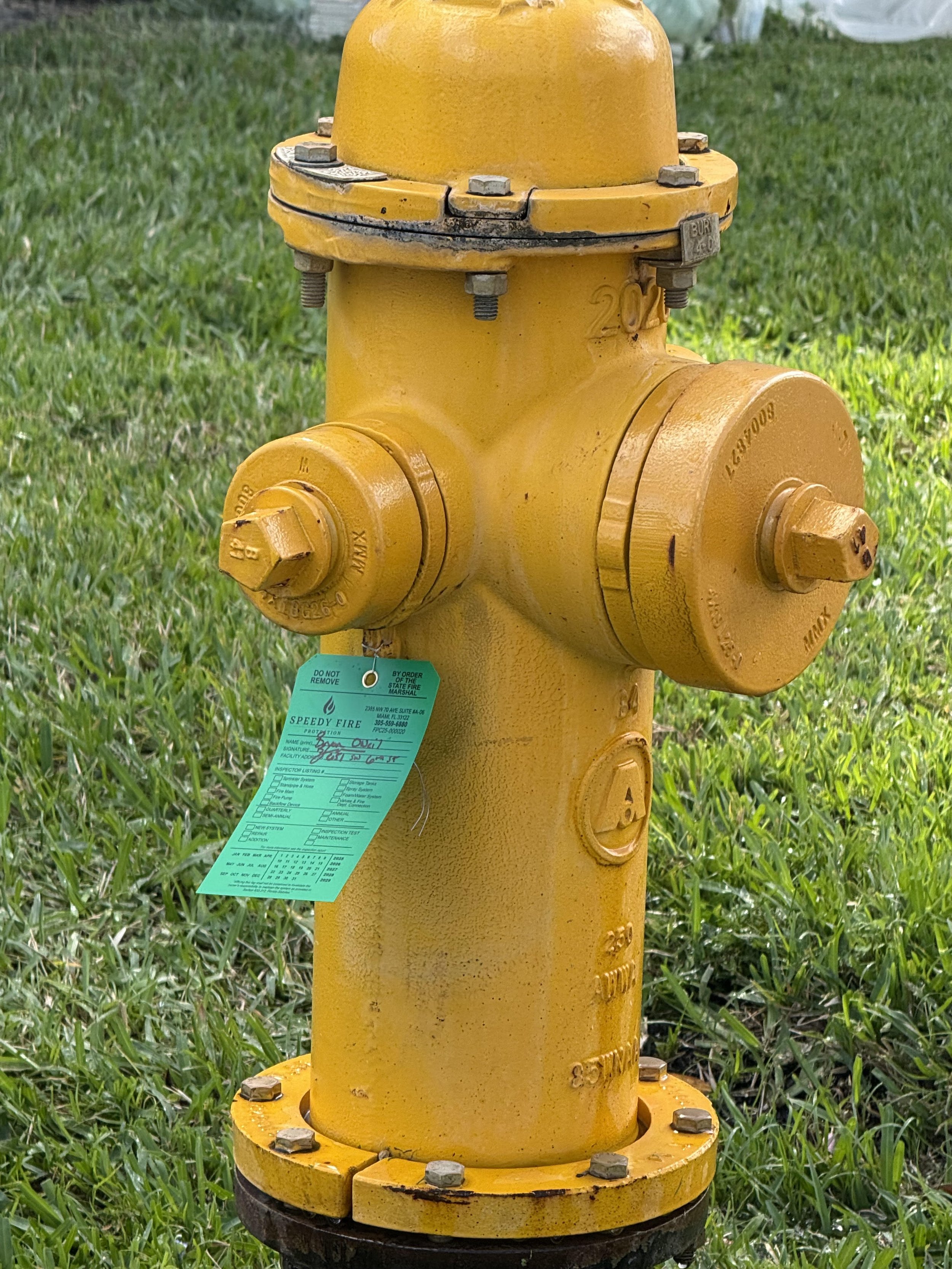
Private fire hydrant inspection, repair, replacement, and installation in Miami-Dade is the property owner's responsibility under NFPA 25. Learn what's required, what fails, and how to stay compliant in South Florida.
A Miami-Dade Fire Rescue inspector walks your commercial property during your annual Life Safety Operating Permit inspection. The sprinkler riser room is clean, documentation is current, and the fire alarm panel is in good order. Then the inspector walks to the parking lot and notes the private fire hydrant at the rear of the property. The cap is corroded shut. The barrel has not been flushed in years. No annual flow test has been performed and no record of one exists. A violation is issued. The comply-by window is 30 days.
Most property managers in Miami-Dade understand that fire sprinklers, fire alarms, and fire pumps require annual inspections and documentation. Private fire hydrants on their property are often overlooked entirely, because there is a widespread assumption that fire hydrants are the city's problem. That assumption is wrong when the hydrant sits on private property. When a fire hydrant is located on private property, the owner is fully responsible for inspections, testing, maintenance, repairs, and compliance recordkeeping. The municipality maintains public hydrants. Everything on your side of the property line is yours.
This post covers what Speedy Fire Protection provides across the full scope of private fire hydrant services in Miami-Dade and South Florida: annual inspections and flow testing, repairs and component replacement, full hydrant replacement, and new hydrant installation for commercial developments, industrial facilities, warehouse campuses, and multifamily properties.
Who Owns the Hydrant and Why It Matters
The distinction between public and private fire hydrants is the foundation of everything else in this post. Understanding it prevents the compliance assumption that gets properties cited.
Public fire hydrants are owned and maintained by the municipality or water authority. In Miami-Dade, that means Miami-Dade Water and Sewer Department for unincorporated areas, or the relevant municipality for incorporated cities. These hydrants are part of the public water distribution system and their upkeep falls to the government, not the adjacent property owner.
Private fire hydrants are installed on private property to serve the fire protection needs of that specific building or campus. They are commonly found at warehouses and distribution centers where the building footprint exceeds what a single street-side public hydrant can adequately serve, at hospital and healthcare campuses with multiple structures, at large multifamily complexes and HOA-governed communities, at industrial facilities with high-hazard occupancies, and at any commercial development where the fire protection engineer determined on-site water supply access was required by the fire authority.
A fire hydrant on private property is the legal responsibility of the property owner for all inspection, testing, maintenance, and repair requirements. This obligation does not transfer to the municipality, the water utility, or Miami-Dade Fire Rescue. If the hydrant fails to deliver adequate water during a fire because it was not properly maintained, the property owner is exposed to liability, enforcement action, and insurance consequences. If the Life Safety Operating Permit inspection surfaces a hydrant deficiency, the building owner is responsible for correcting it on the AHJ's timeline.
What Annual Inspection and Flow Testing Requires
Private fire hydrant inspection and testing requirements are governed by NFPA 25: Standard for the Inspection, Testing, and Maintenance of Water-Based Fire Protection Systems, Chapter 7, which covers Private Fire Service Mains. Florida adopts NFPA 25 under the Florida Fire Prevention Code, making these requirements enforceable obligations for all covered properties in Miami-Dade.
NFPA 25 Table 7.1.1.2 directs annual testing of private fire hydrants, requiring them to be fully opened and flowed for a minimum of one minute. This flow test verifies that the hydrant operates correctly, clears debris from the barrel, and confirms that water supply to the hydrant is intact. Flow shall be maintained until the discharge runs clear. After closing, a dry-barrel hydrant must drain completely within 60 minutes. Failure to drain is a serious deficiency indicating a faulty drain valve or backpressure condition that could lead to a frozen or damaged barrel, though in South Florida, freezing is not the concern. Water left standing in a barrel in a humid coastal environment accelerates internal corrosion and can prevent the hydrant from operating when opened.
Beyond the flow portion, the annual inspection covers a full visual and operational evaluation. A qualified technician checks the hydrant body for cracks, corrosion, and impact damage. Caps and threads are inspected and lubricated. Stems, caps, and operating mechanisms are lubricated annually to ensure the operating nut turns freely and the valve opens fully without binding. Missing or damaged caps are replaced. The hydrant is checked for adequate clearance: a minimum three-foot clear space must be maintained around the circumference of the hydrant and it must be accessible from the roadway for fire department apparatus. Vegetation overgrowth, parked vehicles, and construction materials routinely obstruct hydrants at warehouse and industrial properties in Miami-Dade, and all of it must be cleared.
Every five years, NFPA 25 also requires an underground and exposed pipe flow test for private fire service mains, conducted in accordance with NFPA 291: Recommended Practice for Fire Flow Testing and Marking of Hydrants. This test evaluates available water supply at the hydrant under flow conditions, recording static pressure, residual pressure while flowing, and pitot-derived gallons-per-minute calculations. These results are used to confirm the water supply meets the fire protection system's hydraulic demand and to verify the hydrant's capacity marking is still accurate. Flow capacity markings on fire hydrants use a color-coding system to indicate available gallons per minute, and those markings must reflect current conditions. If the water supply has changed, the marking must be updated.
Our inspection and testing team performs annual hydrant inspections, operational flow testing, and five-year NFPA 291-compliant water supply flow tests across Miami-Dade, Broward, and Palm Beach, producing the documentation that satisfies both NFPA 25 and Miami-Dade Fire Rescue.
Common Failure Points and What Repair Involves
Private fire hydrants fail in predictable ways, and most failures are the direct product of deferred maintenance. In South Florida's building stock, where many commercial and industrial properties were developed in the 1970s, 1980s, and 1990s, hydrants have been in service for 30 to 50 years in some cases. Age alone does not determine condition, but age combined with infrequent maintenance almost always does.
Corroded caps and seized operating mechanisms. The most common finding during annual inspection of a neglected private hydrant in Miami-Dade is a cap that cannot be removed and an operating nut that will not turn. Salt-laden coastal air accelerates corrosion of brass and iron components. When a hydrant cannot be opened by a fire crew because the cap is seized or the stem is corroded shut, it is effectively non-functional regardless of the water supply behind it. Repair involves removing corroded caps with specialized tools, cleaning and inspecting cap threads, replacing damaged caps with new ones, lubricating the operating mechanism, and confirming free operation through a full open-and-close cycle.
Leaking packing and valve seats. A hydrant that seeps water from around the stem or that cannot be fully closed has a packing failure or a damaged valve seat. Both are repairable without replacing the entire hydrant. The operating nut and stem assembly is removed, packing is replaced, and the valve seat is inspected and repaired or replaced. A hydrant with a slow leak that has been left unrepaired for months or years will typically show accelerated internal corrosion and may require more extensive work than if the problem had been caught during an annual inspection.
Damaged barrels and broken flanges. Hydrants in parking lots, loading dock areas, and industrial yards are vulnerable to vehicle impact. A hydrant struck by a forklift, truck, or delivery vehicle will typically show a broken or cracked barrel, a damaged flange, or a bent operating stem. Many hydrants are designed with a breakaway flange at the base intended to shear upon impact without damaging the underground supply line, but the hydrant above ground must still be repaired or replaced. Broken flanges and cracked barrels are not repairable; they require replacement of the hydrant barrel section or the entire above-ground assembly.
Drainage failure. A dry-barrel hydrant that retains water in the barrel after closing has a failed drain valve. Standing water in the barrel damages internal components and prevents the hydrant from functioning in the full-open position. Repair requires removal and replacement of the drain valve mechanism, followed by a drain test to confirm the barrel empties within the 60-minute NFPA 25 window.
When a hydrant's repair cost approaches or exceeds the cost of replacement, or when the internal components are no longer available for the hydrant's model, replacement is the correct decision. Our service and repair team assesses each hydrant individually, provides a clear repair versus replacement recommendation based on condition and cost, and carries out the work with all required permitting and documentation.
Hydrant Replacement and New Installation: What the Process Looks Like
Hydrant replacement and new installation are both permitted fire protection projects in Miami-Dade. They are not plumbing work performed by a general contractor. All work on private fire service mains and their appurtenances, including hydrants, must comply with NFPA 24: Standard for the Installation of Private Fire Service Mains and Their Appurtenances and must be performed by a licensed contractor authorized for fire protection work. In Miami-Dade, that means a Florida Licensed Fire Sprinkler Contractor with the appropriate certification for underground fire service work.
Hydrant replacement begins with isolating the underground supply line at the nearest control valve, removing the existing hydrant assembly, and installing a new hydrant matched to the supply line size and the required flow capacity. The new hydrant must meet the height requirements in the applicable code: the horizontal midline of the pumper connection must be between 18 and 36 inches above final grade. After installation, the system is pressure-tested, flushed, and flow-tested to confirm proper operation before the permit inspection. Miami-Dade Fire Rescue's Fire Prevention Division reviews and inspects installations for fire suppression systems, and the inspection must be passed before the hydrant is returned to service.
New hydrant installation for a commercial development, warehouse campus, or multifamily property follows a more involved process. Shop drawings reflecting compliance with NFPA 24 must be submitted to the Fire Department for review. Hydraulic calculations may be required to verify that the proposed supply pipe size can deliver the required fire flow at the hydrant location. The supply pipe must be sized to deliver the required flow without exceeding acceptable velocity limits under NFPA 24 and the local fire authority's requirements. Hydrant placement is determined in coordination with Miami-Dade Fire Rescue to ensure fire apparatus can access the hydrant from an approved access road without obstruction.
Miami-Dade Fire Rescue's Fire Prevention Division also specifies that the fire department connection must be located no more than 150 feet from a hydrant. New hydrant installations on properties with existing fire protection systems must account for this relationship. A new development that locates a hydrant outside that 150-foot radius will receive a plan review comment requiring relocation before the permit is issued. Getting the hydrant placement right at the design stage avoids a costly field correction.
Our design and installation team handles the full scope of new hydrant installation projects: design, hydraulic calculations, plan submission to Miami-Dade Fire Rescue, trenching coordination, installation, pressure testing, flushing, flow testing, and permit closeout. We manage the entire process from plan approval to final inspection.
How to Stay Ahead of Fire Hydrant Compliance in Miami-Dade
Private fire hydrant compliance is straightforward to maintain when it is built into the annual fire protection calendar. It becomes an enforcement problem only when it is forgotten.
First, confirm whether your property has a private fire hydrant. Walk the perimeter of your building, parking lot, and any outbuildings. Look for above-ground red or yellow painted standpipes with capped outlets, typically located near roadway access points, building corners, or along the side of the property away from the street. If you are unsure whether a hydrant on or near your property is public or private, the location relative to the property line and the presence of a dedicated underground supply line on your fire protection system drawings will clarify ownership.
Second, schedule the annual inspection and flow test with a licensed fire protection contractor. The inspection must be performed annually and the results documented. If your hydrant has not been inspected within the last 12 months, schedule service before the next Life Safety Operating Permit inspection surfaces the deficiency. Annual testing takes approximately one to two hours per hydrant and requires a brief water shutdown of the hydrant supply line.
Third, address every deficiency the inspection report identifies. A failed cap, a seized operating nut, a leaking packing, or a drain failure are not minor maintenance items. Each represents a condition that could prevent the hydrant from functioning during a fire. NFPA 25 requires that deficiencies be corrected promptly, and Miami-Dade Fire Rescue treats open hydrant deficiencies with the same enforcement posture as any other documented life-safety impairment under Florida Statute 633.124.
Fourth, track the five-year underground flow test schedule. If your property's private fire service mains have not undergone a five-year NFPA 291 flow test, coordinate that work alongside the next annual inspection. It requires flowing water at volume and should be scheduled at a time that minimizes disruption to building operations and neighboring properties. Our inspection and testing team will advise on scheduling and coordinate with the local water authority as needed.
Speedy Fire Protection: Full Fire Hydrant Services Across Miami-Dade and South Florida
Speedy Fire Protection has provided licensed fire protection services in Miami-Dade, Broward, and Palm Beach since 2005 as a Florida Licensed Fire Sprinkler Contractor (#FPC25-000020). Our Vice President Bryan O'Neil holds a NICET Level III certification in Inspection and Testing of Water-Based Systems, one of the highest technical credentials available in the fire protection industry.
We perform the full spectrum of private fire hydrant services for commercial buildings, industrial facilities, warehouse campuses, hospitals, government properties, and multifamily communities across South Florida. That includes annual inspections and operational flow testing per NFPA 25 Chapter 7, component repairs including caps, stems, packing, and drain valves, five-year NFPA 291 underground flow testing, hydrant replacement under permit, and new hydrant installation from plan submission through final inspection.
If your property has a private fire hydrant that has not been inspected, repaired, or documented, contact Speedy Fire Protection to schedule service. If you are planning a new development or addition that requires hydrant installation, our design team can scope the project and guide it through Miami-Dade Fire Rescue's plan review process from the start.
Frequently Asked Questions
Q: How do I know if the fire hydrant on my property is private or public?
Location relative to your property line is the primary indicator. If the hydrant is located on your property, inside your fence line, in your parking lot, or connected to a dedicated underground supply line that serves only your building, it is almost certainly a private hydrant and your responsibility. Public hydrants are installed in the public right-of-way, typically adjacent to the street curb or in a dedicated easement controlled by the municipality or water authority. If you are uncertain, your fire protection system drawings will show whether a private fire service main feeds the hydrant. Your licensed fire protection contractor can also confirm ownership during an on-site visit.
Q: How often does a private fire hydrant need to be inspected in Miami-Dade?
NFPA 25 Chapter 7, adopted by Florida under the Florida Fire Prevention Code, requires annual inspection and flow testing of private fire hydrants. The hydrant must be fully opened and flowed for a minimum of one minute, with discharge continuing until clear. The operating mechanism, caps, threads, and drainage function must all be evaluated and documented. Separately, every five years the underground and exposed private fire service mains require a flow test conducted in accordance with NFPA 291 to verify available water supply and confirm hydrant capacity markings are accurate.
Q: What are the most common reasons a private fire hydrant fails its annual inspection?
The most common findings in Miami-Dade are corroded or seized caps that cannot be removed, operating nuts that will not turn freely due to lack of lubrication, leaking packing around the stem, drainage failure (water remaining in the barrel after closing), missing caps leaving the outlet threads exposed to debris and corrosion, and clearance violations from vegetation overgrowth or vehicle parking obstruction. Valve leaks, corrosion, and inadequate water pressure are also frequently cited during inspections. All of these are preventable with a consistent annual inspection and maintenance program.
Q: What happens if my private fire hydrant is cited in a Miami-Dade fire inspection?
The citation will appear on your Fire Inspection Report as a violation with a comply-by date, typically 30 days from the inspection date. You must correct the deficiency, document the correction, and be prepared to demonstrate compliance at the follow-up inspection.
Speedy Fire Protection is a Florida Licensed Fire Sprinkler Contractor (#FPC25-000020) serving Miami-Dade, Broward, Palm Beach, and surrounding South Florida counties. This article is for informational purposes only and does not constitute legal advice. Consult a licensed fire protection contractor and qualified legal counsel for guidance specific to your property.