Fire vs Domestic Backflow Preventers in Miami-Dade: What’s the Difference?
Property managers and engineers in Miami-Dade hear “backflow” and immediately think inspection delays, failed city tests, and surprise repair bills. The problem is that people lump two very different things together:
domestic backflow (your building’s potable water system)
fire-line backflow (your fire sprinkler and standpipe supply)
They are not the same, they are not tested the same way, and they often do not get installed for the same reason.
This guide breaks down the difference in practical, field-useful terms. At the bottom of this guide, you will also find FAQs.
Quick definitions
Domestic backflow preventer: Installed on the potable (drinking) water service feeding the building’s domestic plumbing: sinks, toilets, kitchens, mechanical equipment, etc. Reduced Pressure (RP) assemblies are typically installed at the domestic water service connection.
Fire-line backflow preventer: Installed on the water service feeding fire suppression systems, usually your sprinkler and/or standpipe. Double Check Valve Assembly (DCVA) and Double Check Detector Assembly (DCDA) are typically installed at the water service connection supplying fire suppression systems.
Why do two different backflows exist?
The core reason is hazard and cross-connection risk.
Domestic plumbing has lots of potential cross-connections to contaminants: chemicals, boilers, cooling towers, hose bibbs, process equipment, kitchens, etc, which means these water utilities often require stronger protection.
Fire sprinkler piping is usually “just water,” but the system can sit stagnant for long periods, can contain corrosion products, and in some cases can include additives or auxiliary supplies. Utilities treat this as a cross-connection risk too, so they often require specific “fire service” assemblies.
Miami-Dade’s guidance is straightforward: different services (domestic, fire suppression, irrigation) can require different backflow assembly types based on hazard and use.
The hardware differences you’ll actually see on site
Domestic assemblies (common in commercial buildings)
Most common: RP (Reduced Pressure Principle Assembly), sometimes DC (Double Check) depending on local utility rules and hazard classification.
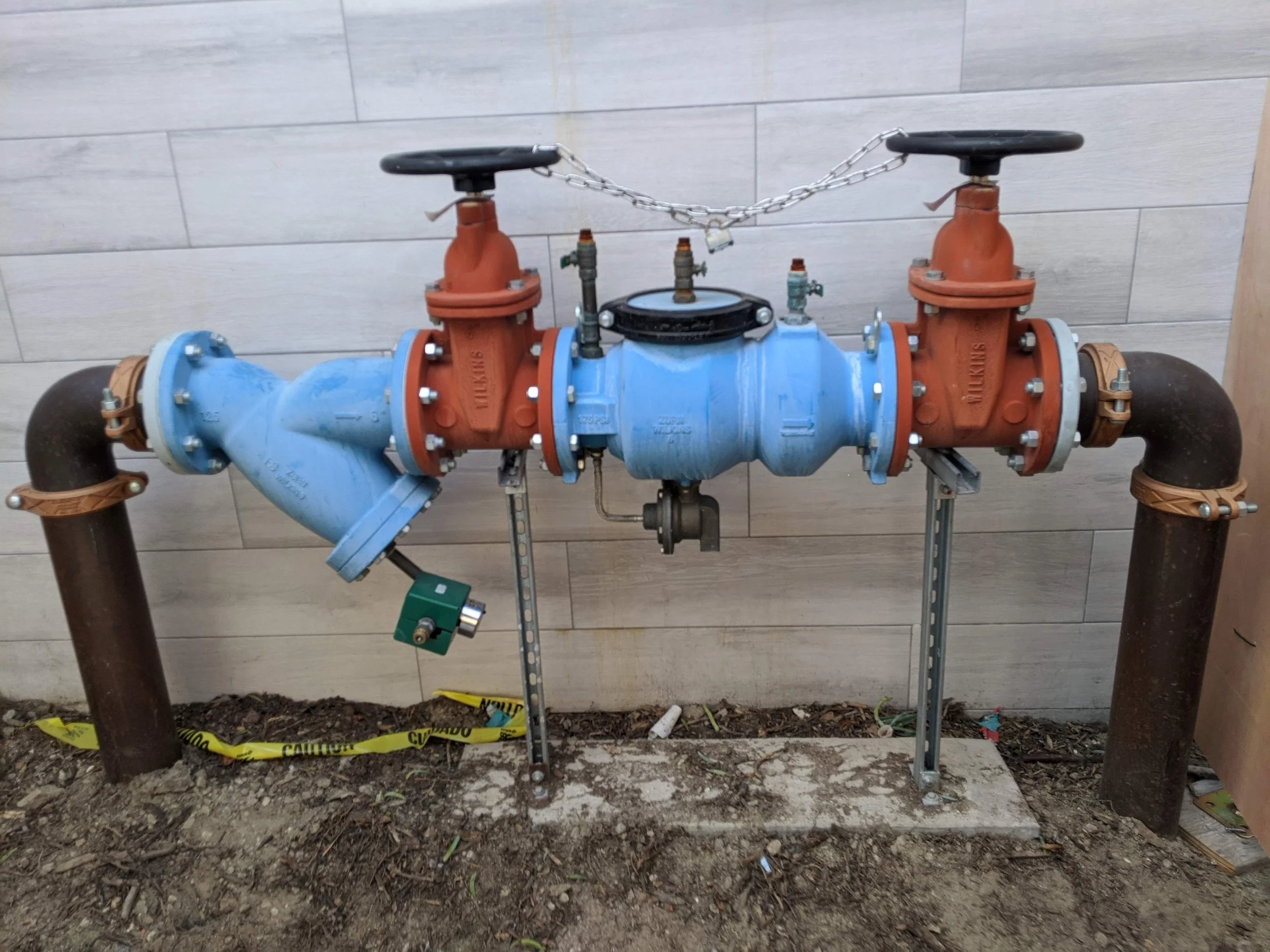
What it looks like:
two shutoff valves
test cocks
a relief valve discharge (for RP assemblies)
Field clue: RP assemblies often have a relief port and can dump water during failure or testing. Miami-Dade’s brochure notes RP assemblies are typically installed at the domestic water service connection.
Fire assemblies (common for sprinkler and standpipe)
Most common: DCDA (Double Check Detector Assembly) or DCVA for fire lines. In higher hazard scenarios (additives, auxiliary supplies), some utilities require an RPDA (Reduced Pressure Detector Assembly). (Utility rules vary by county and water department, so you always verify with the serving utility.)
What it looks like:
larger body and valves
“detector” feature on many fire lines: a small bypass line and a small meter to detect unauthorized use or leaks (very common on fire service)
often installed near the fire service entrance, sometimes with a dedicated fire line meter arrangement separate from domestic.
Miami-Dade specifically calls out DCVA and DCDA as typical for fire suppression service connections.
The biggest operational difference: domestic flow vs “no flow” fire systems. Domestic water moves daily. Fire lines often do not.
That creates two real-world consequences:
Fire lines can develop stagnant water conditions, corrosion byproducts, and debris.
Leaks on a fire line can go unnoticed until someone sees water, a pressure switch trips, or the detector meter shows flow.
That’s why the “detector” feature matters: it’s a simple way to identify unauthorized use or hidden leakage on the fire line.
Testing and compliance: who requires what
Domestic backflow testing
Utility-driven. In Miami-Dade, the county code requires assemblies to be tested upon installation and every year thereafter by a certified backflow tester, per the county’s cross-connection control program.
Fire-line backflow testing
Also utility-driven in most cases (same annual test requirement when it’s a utility-mandated assembly). Miami-Dade’s brochure ties annual testing requirements to the county code and cross-connection program and explicitly includes fire suppression services in the services covered.
Separate but important: sprinkler systems themselves are inspected and tested under NFPA 25.
Backflow testing is not a substitute for sprinkler Inspection, Testing, and Maintenance (ITM), and fire sprinkler ITM is not a substitute for utility backflow compliance.
Practical: how to tell if you’re looking at a fire or domestic backflow
Use this quick checklist on a site walk:
1. Where is it located?
● Domestic: typically right after the domestic meter/service entering the building.
● Fire: typically on a dedicated fire service line, often near the FDC/risers/fire pump room feeds, and sometimes labeled as fire line.
2. Is there a detector meter or bypass meter?
● Very common on fire backflows (DCDA/RPDA).
3. How is it labeled on plans and tags?
● Fire lines should be identified as fire suppression service.
● Domestic should be labeled as potable/domestic service.
4. What size is it?
● Fire lines are often larger, but not always. When in doubt, ask for the last test report. The test form usually identifies the assembly type and service.
Which one “matters more” for property risk?
They matter, but for different reasons.
Domestic backflow risk
Public health and regulatory enforcement. A failed domestic backflow can become a utility compliance issue fast.
Fire-line backflow risk
Still a public health issue for the utility, but it also directly intersects with life safety operations. If someone shuts down the fire backflow for repairs and forgets to restore it, you can end up with a fire sprinkler impairment situation. Closed valves are one of the most common real-world causes of sprinkler systems failing to operate when needed.
So for a property manager, fire-line backflow has a “life safety plus compliance” profile, and domestic has a “public health plus compliance” profile.
FAQ
What is the difference between fire and domestic backflow?
Domestic backflow protects the potable water system serving sinks, toilets, kitchens, and equipment. Fire backflow protects the public water supply from the fire sprinkler/standpipe system connection and is typically installed on the fire suppression service line. Miami-Dade guidance lists RP assemblies as typical for domestic services and DCVA/DCDA as typical for fire suppression services.
Does Miami-Dade require annual backflow testing for both?
Miami-Dade Water and Sewer’s guidance states the county code requires backflow assemblies to be tested upon installation and every year thereafter by a certified tester, and it applies to services including domestic and fire suppression depending on hazard and use.
What is a DCDA and why is it used on fire lines?
A DCDA is a Double Check Detector Assembly. It’s commonly used on fire suppression service lines and often includes a detector feature to identify small flows that could indicate leaks or unauthorized use. Miami-Dade lists DCDA as typical for fire suppression services.
Why does my building have two backflow preventers?
Many Miami-Dade properties have a domestic service and a separate fire service. Utilities may require different backflow assemblies on each service because the hazard and use differ.
Do I need a permit to install or replace a backflow preventer in Miami-Dade?
A permit is typically required for installation and the permit fee is determined by the municipality where the assembly is installed.
If you have any questions or concerns, contact us and we would be happy to assist!