Fire Pumps in Miami-Dade: What Property Managers and HOA Boards Need to Know About Inspections, Repairs, and When to Replace
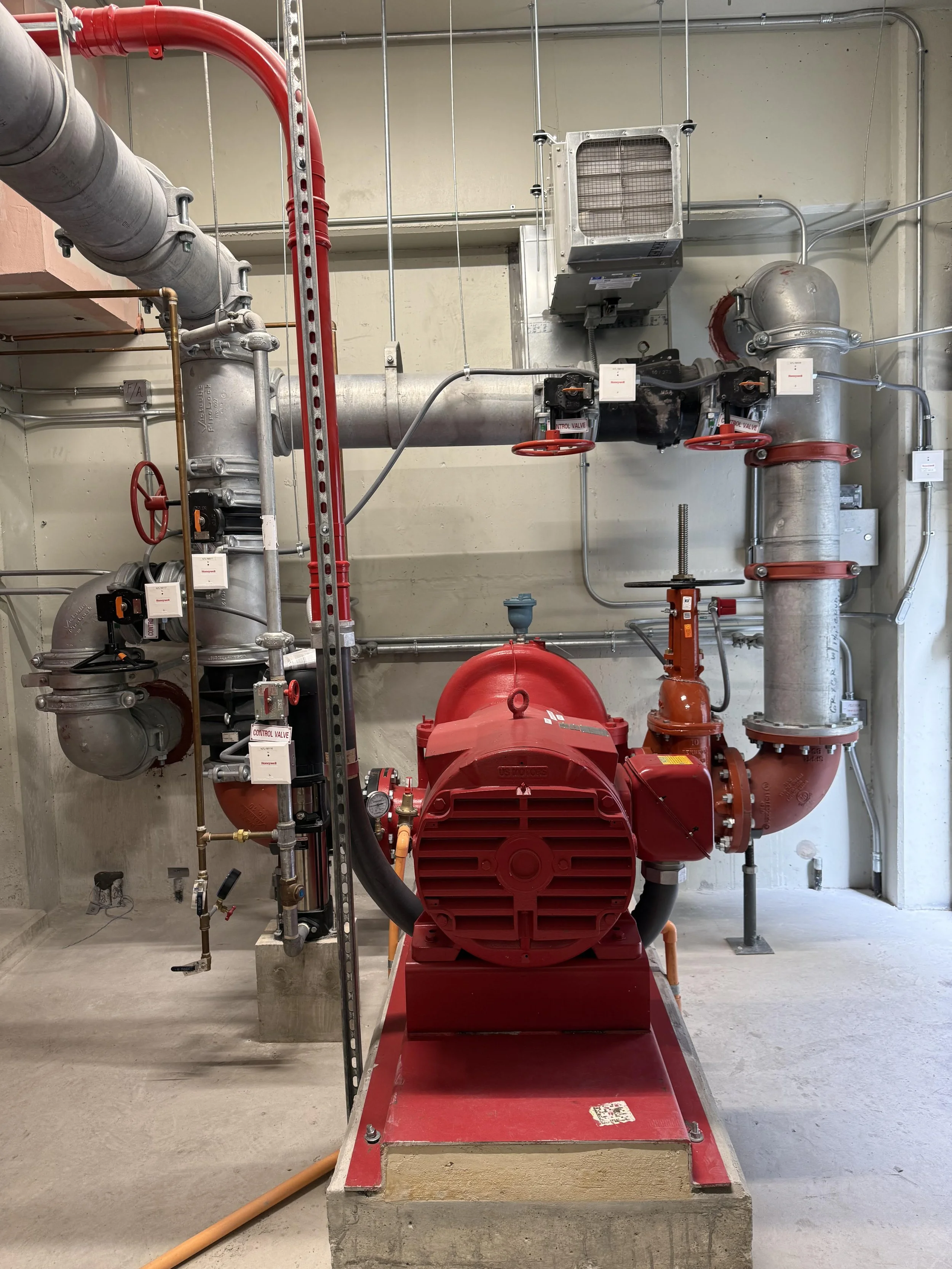
The annual fire pump flow test results come back and the numbers are trending down for the third year in a row. Net pressure at 150% rated flow is sitting at 83% of the pump curve. The technician notes bearing wear, packing that needs adjustment, and a controller with corroded circuit boards. The pump is 22 years old. Your board meeting is in two weeks and someone is going to ask the question: do we repair it, or do we replace it?
This is not a hypothetical scenario. It plays out in condo associations, commercial property portfolios, and institutional facilities across Miami-Dade every year. Fire pumps are the heart of any building's water-based fire protection system. When the municipal water supply cannot provide enough pressure to reach the sprinkler system's hydraulic demands, the fire pump is what closes that gap. If it fails during a fire, the sprinkler system fails with it. The decision to repair or replace is consequential, and it cannot be made responsibly without understanding what the inspection record is actually telling you.
This post covers the full fire pump compliance picture for South Florida buildings: the inspection and testing schedule under NFPA 25 and NFPA 20, what the test results mean, how to evaluate repair versus replacement, and the specific challenges that Miami-Dade's building stock and regulatory environment create for property managers and HOA boards.
What NFPA 25 Requires: The Full Fire Pump Inspection and Testing Schedule
Fire pump inspection and testing requirements are governed by NFPA 25: Standard for the Inspection, Testing, and Maintenance of Water-Based Fire Protection Systems, Chapter 8. Florida adopts NFPA 25 under the Florida Fire Prevention Code, making these requirements enforceable obligations for all covered commercial and multifamily occupancies in Miami-Dade.
Weekly no-flow (churn) testing. Diesel engine-driven fire pumps must be tested weekly under no-flow conditions. The pump is started and run for a minimum of 30 minutes without water flowing. Technicians verify that the pump starts automatically when pressure drops, record suction and discharge pressures, check for unusual noise, vibration, or leaks, and confirm the engine and battery systems are operational. Electric fire pumps serving high-rise buildings, vertical turbine pumps, systems with limited-service controllers, or systems supplied by non-pressurized water sources are also subject to weekly testing. Most other electric pumps require monthly no-flow testing. These tests must be conducted by qualified personnel in attendance. Records must be retained for at least one year and made available to Miami-Dade Fire Rescue upon request.
Annual flow testing. Once per year, every fire pump must undergo a full performance flow test under three conditions: no-flow (churn), 100% of rated capacity, and 150% of rated capacity. NFPA 25 Section 8.3.3.1 requires that the test results be considered acceptable if net pressure at each flow point is at least 95% of the manufacturer's pump curve, the original commissioned field test curve, or the nameplate curve. Results are plotted against the pump curve and compared to prior years. This year-over-year trending is what allows a qualified contractor to identify degradation before it reaches the point of non-compliance. If the pump fails to meet the 95% threshold, it is out of compliance and corrective action is required.
Additional five-year and ongoing requirements. Diesel pump fuel must be tested annually for degradation to prevent engine failure during an emergency. Electrical connections must be checked annually. Printed circuit boards on electric pump controllers must be inspected annually for corrosion. Pressure gauges must be replaced or recalibrated every five years. These requirements exist because fire pump failure is often not sudden. It is a product of accumulated neglect across components that are rarely visible during routine operations.
Reading the Annual Test Results: What the Numbers Are Actually Telling You
An annual flow test report is more than a compliance document. It is a diagnostic record. Property managers and HOA boards who treat it as a box-checking exercise miss the most important information it contains.
The pump curve comparison is the critical output. When a pump is new and commissioned, a baseline performance curve is established. Every year thereafter, the flow test results are corrected for actual running speed using pump affinity laws and plotted against that baseline. A pump that produces results declining toward the 95% threshold year after year is telling you that internal wear, including impeller erosion, casing wear, or shaft degradation, is progressing. The pump is not yet out of compliance, but the trajectory is clear. Planning should begin before the numbers cross the line.
Beyond the curve data, the annual test report surfaces operational findings that require immediate attention. Excessive vibration during the flow test indicates bearing wear or shaft misalignment. Unusual noise at rated flow suggests impeller damage or cavitation. Packing gland leakage beyond normal weep rates signals that repacking is overdue. A pump that starts slowly or fails to meet the no-flow churn pressure specified on the nameplate is showing controller or driver problems. Each of these findings maps to a specific repair category with its own cost and urgency profile.
Miami-Dade Fire Rescue's Life Safety Operating Permit inspections require documentation of annual fire pump testing. Inspectors may request the prior year's report and findings. A pattern of declining performance with no documented corrective action is a compliance exposure that goes beyond the technical condition of the pump itself. It creates a record showing the building owner was aware of a life-safety system deficiency and did not respond.
Repair vs. Replacement: The Framework for Making a Sound Decision
The decision between repairing a fire pump and replacing it is not primarily a question of age or cost in isolation. It is a question of remaining useful life, parts availability, regulatory compliance, and the cumulative risk of continued repair without addressing underlying degradation.
The lifespan baseline. Well-maintained horizontal split-case fire pumps, the most common type in Miami-Dade commercial and high-rise buildings, have a typical lifespan of 25 to 40 years when properly installed and maintained. Vertical inline pumps have a shorter expected life of 7 to 15 years. Diesel engine-driven pumps experience more wear than electric pumps due to engine complexity and the volume of moving parts. Fire pump controllers typically have a lifecycle of 20 to 25 years, and coastal environments with high salt concentration in the air can reduce that controller lifecycle by approximately 25%. That last point is directly relevant to every waterfront high-rise and coastal commercial property in Miami-Dade and Broward.
When repair is the right answer. A pump in the first half of its expected lifespan that is failing an annual test for a specific, isolatable reason is a repair candidate. Repacking the glands, replacing bearings, servicing the controller, or rebuilding an impeller are targeted interventions that restore performance without the cost and project complexity of full replacement.
When replacement becomes necessary. Replacement becomes the correct decision under several conditions. The pump fails the annual flow test and targeted repair cannot restore performance above the 95% threshold. Parts for the existing model are discontinued or on extended backorder from the manufacturer. The cumulative cost of recent and projected repairs approaches or exceeds 50% of the cost of a new installation. The pump's performance degradation is structural, meaning the casing, impeller, or shaft are worn to the point where repair provides only temporary improvement before the same problem recurs. NFPA 20 and NFPA 25 do not mandate replacement based on age alone, but the AHJ may require it after 25 or more years based on documented risk factors. And critically: if the building's sprinkler system has been upgraded, expanded, or modified since the original pump was installed, the existing pump may no longer meet the current hydraulic demand even in good mechanical condition. Any pump replacement should be preceded by a hydraulic review of the current system demands to confirm the new pump is properly sized. Installing a like-for-like replacement in a building whose fire protection requirements have changed is a compliance error that an experienced fire protection contractor will catch before the work begins.
The 50% rule as a practical guide. When total repair cost, including parts, labor, and the reasonable expectation of follow-on repairs within the next two to three years, approaches or exceeds half the cost of a new pump installation, the economics favor replacement. A new pump restarts the clock on lifecycle, comes with manufacturer warranty coverage, meets current NFPA 20 requirements, and eliminates the compliance exposure of operating aging equipment with a documented performance record trending toward failure.
Unique Challenges for Miami-Dade and South Florida Buildings
Miami-Dade's building stock presents fire pump challenges that are specific to this market and not adequately addressed by generic fire protection guidance.
Coastal corrosion and salt air. Saltwater-adjacent properties in Brickell, Miami Beach, Aventura, and throughout Broward's coastal corridor subject fire pump equipment to an accelerated corrosion environment that inland facilities do not face. Salt-laden air corrodes fire pump components more rapidly, reducing the useful life of the controller, the motor housing, and exposed mechanical parts. A pump installed at a waterfront high-rise may reach the end of its practical service life meaningfully earlier than the same model installed in an inland commercial building with controlled mechanical room conditions. Buildings in this situation should establish more aggressive inspection intervals and evaluate controller condition more frequently than the standard five-year cycle.
Hurricane season and power reliability. South Florida's hurricane exposure creates a specific reliability question for electric fire pumps: what happens to water pressure in the sprinkler system when the building loses grid power during a storm? NFPA 20 requires that electric motor-driven fire pumps have a reliable source of emergency power or a backup fire pump when the primary electrical supply is not considered reliable. In high-rise buildings, NFPA 20 for high-rise applications requires that fire pumps serving zones beyond fire department pumping capacity have a fully independent backup pump arranged so full fire protection demand can be maintained with any one pump out of service. For HOA boards and property managers evaluating a pump replacement, the question of backup power or a jockey pump arrangement deserves explicit attention from the fire protection engineer scoping the project.
Aging high-rise inventory. A significant portion of Miami-Dade's high-rise residential and commercial inventory was constructed between the 1970s and the 1990s. Buildings in that era are now 30 to 50 years old, placing their original fire pumps at or beyond the end of expected useful life. Many of these buildings are also subject to the milestone inspection requirements of SB 4-D, which evaluate life safety systems as part of the structural assessment process. A fire pump that fails during a milestone inspection creates a compliance problem that affects the building's ability to obtain its Structural Integrity Reserve Study certification and, in some cases, its Life Safety Operating Permit renewal. Proactive replacement, planned and permitted in advance rather than driven by an inspection failure, gives HOA boards more control over timing, cost, and disruption to residents.
Permitting through Miami-Dade Fire Rescue. Any fire pump replacement in Miami-Dade requires permitting through the appropriate authority. For unincorporated Miami-Dade properties, that means Miami-Dade Fire Rescue's Fire Prevention Division. For City of Miami-addressed properties, it means the City of Miami Fire Prevention Bureau. The contractor performing the replacement must hold a valid Florida Licensed Fire Sprinkler Contractor certificate. Unlicensed fire pump work is a misdemeanor under Florida Statute 633.336. Boards that hire general mechanical contractors or plumbing firms without verifying fire protection licensing create both a safety problem and a legal exposure.
How to Stay Ahead of Fire Pump Failures Before They Force Your Hand
Reactive fire pump decision-making, driven by a failed test, an AHJ citation, or an emergency, is the most expensive and disruptive version of this problem. The building with a 25-year-old pump that the board has been watching for three years has options. The building that discovers its pump fails the annual test six weeks before a major insurance renewal has far fewer.
First, establish a performance trend file. Every annual flow test report should be retained and compared year over year. The comparison should track net pressure at each of the three flow points against the pump curve baseline. When any data point falls below 97% of the rated curve, that is the signal to commission a detailed evaluation by a qualified fire protection contractor. Industry guidance consistently identifies a 25-year useful life as a planning benchmark. If your pump is 18 years old and trending downward, replacement planning should begin now, not when the test fails.
Second, budget for replacement before it is required. HOA reserve studies and commercial property capital budgets should include fire pump replacement as a line item with a projected replacement date based on age and performance trend. A horizontal split-case pump replacement project in a Miami-Dade high-rise, including new pump, controller, associated piping, permitting, and commissioning, is a significant capital expenditure. Boards that have not reserved for it are in a reactive position when the failure arrives. Our fire sprinkler service and repair team can provide a written assessment of your pump's current condition and projected replacement timeline to support reserve study planning.
Third, never defer a failed pump test without an impairment plan. If an annual flow test produces results below the 95% threshold, the pump is out of compliance under NFPA 25. Operating the building with a non-compliant fire pump is a documented life-safety deficiency. The Florida Fire Prevention Code and Florida Statute 633.124 make sustained non-compliance a misdemeanor exposure for the building owner or responsible party. Corrective action must be taken promptly, and if repair or replacement will take time, an impairment coordinator must be designated, the fire department notified, and a fire watch implemented as required by NFPA 25 Chapter 15.
Fourth, use the replacement project as an opportunity to right-size the system. Before any pump replacement is scoped, commission a hydraulic analysis of the current fire protection demand. If the building has been renovated, expanded, or has different occupancy than when the original pump was installed, the replacement is an opportunity to install equipment that correctly matches what the system actually needs today, not what it needed in 1992.
Speedy Fire Protection: Fire Pump Expertise Across Miami-Dade
Speedy Fire Protection has been a Florida Licensed Fire Sprinkler Contractor (#FPC25-000020) serving Miami-Dade, Broward, and Palm Beach since 2005. Our team holds NICET Level III certification in Inspection and Testing of Water-Based Systems, one of the highest technical credentials in the fire protection industry, and we bring 20-plus years of hands-on experience with fire pump systems across South Florida's diverse building stock.
We perform fire pump weekly churn testing, annual flow tests per NFPA 25 Section 8.3, performance trending analysis, and targeted repair work. When replacement is the right answer, we manage the permitting, installation, and commissioning process under NFPA 20 through Miami-Dade Fire Rescue. We work with HOA boards, property managers, and institutional facilities managers to build the compliance calendar and capital planning framework that prevents fire pump emergencies from becoming board emergencies.
If your building's fire pump is approaching the end of its expected service life, has not had a documented annual flow test, or has a repair history that warrants a replacement evaluation, contact Speedy Fire Protection for a consultation. We can also support inspection and testing for buildings that need to establish a clean compliance record before their next Miami-Dade Fire Rescue Life Safety Operating Permit inspection.
Frequently Asked Questions
Q: How often does a fire pump need to be tested in Miami-Dade?
The testing schedule under NFPA 25, adopted by Florida, has multiple intervals. Diesel-driven fire pumps require weekly no-flow (churn) testing. Most electric pumps require monthly no-flow testing, though certain electric pump configurations in high-rise buildings or serving large systems require weekly testing. All fire pumps must undergo a full annual flow test at no-flow, 100%, and 150% of rated capacity. Results must be documented and retained. Miami-Dade Fire Rescue may request this documentation during annual Life Safety Operating Permit inspections.
Q: What does it mean when a fire pump fails its annual flow test?
A fire pump fails the annual flow test when net pressure at any of the three test points (churn, 100% rated flow, 150% rated flow) falls below 95% of the rated pump curve. This is the NFPA 25 Section 8.3.3 compliance threshold. A failed test means the pump cannot reliably deliver the water pressure and volume the fire protection system requires. The building owner must take corrective action promptly. Operating with a known non-compliant fire pump creates legal exposure under Florida Statute 633.124 and insurance exposure under the property policy's protective safeguards provisions. If repair or replacement will take time, an impairment procedure must be implemented, including fire department notification and fire watch if the system is out of service for more than 10 cumulative hours.
Q: How long do fire pumps typically last in South Florida?
Well-maintained horizontal split-case pumps have an expected lifespan of 25 to 40 years. Vertical inline pumps typically last 7 to 15 years. Fire pump controllers have an expected lifecycle of 20 to 25 years, and coastal environments with high salt air concentration can reduce that by approximately 25%. The practical lifespan of any pump in South Florida depends on the quality of the mechanical room environment, the regularity of maintenance, water quality, and whether the pump is diesel or electric. A pump at a well-maintained inland commercial facility will typically outlast the same model at a salt-air-exposed coastal high-rise under equivalent maintenance conditions.
Q: When should an HOA board start planning for fire pump replacement?
Planning should begin no later than when the pump reaches 18 to 20 years of service, or earlier if annual flow tests show a consistent downward performance trend. Industry guidance uses 25 years as a practical replacement benchmark, but that benchmark assumes consistent maintenance and favorable conditions. For South Florida coastal buildings, beginning the replacement evaluation at 18 years is prudent. The replacement project requires permitting, equipment procurement, and coordination with building operations, which can take months. Boards that start planning when the pump is already failing have fewer options and less negotiating leverage on cost and timeline. Replacement should be included as a line item in the building's reserve study with a projected replacement date based on the pump's age and annual test trend data.
Q: Does fire pump replacement require a permit in Miami-Dade?
Yes. Fire pump replacement is a permitted fire protection project requiring review and approval from the AHJ. For unincorporated Miami-Dade properties, that means Miami-Dade Fire Rescue's Fire Prevention Division. For City of Miami-addressed properties, it means the City of Miami Fire Prevention Bureau. The contractor performing the work must hold a valid Florida Licensed Fire Sprinkler Contractor certificate.