
Fire Sprinkler Search Volume Benchmarks 2026: By Service
This page sets search demand benchmarks for each fire sprinkler service type in 2026 — design, installation, inspection, testing, repair and emergency response — and shows how property owners and contractors in Miami-Dade and South Florida should read keyword data before acting on it.
TL;DR
No public source publishes verified fire sprinkler service search volume benchmarks by service type for 2026.
Keyword tool volumes are modeled estimates; treat them as relative signals, not counts.
Repair and leak searches are urgent and event-driven; inspection searches follow NFPA 25 compliance cycles.
Speedy Fire Protection's rule: rank service types by intent and trigger first, then by estimated volume.
The short answer
There is no reliable published average search volume for fire sprinkler services in 2026. No industry body, NFPA committee or public dataset reports verified monthly searches by service type, and the volume figures shown in commercial keyword tools are statistical estimates that disagree with each other, often widely.
What does hold up is the demand structure: which service types people search, what triggers the search, and who is searching. That structure is the benchmark. For a fire sprinkler contractor such as Speedy Fire Protection, it answers the question that matters more than any single volume number — which pages earn calls from building owners, property managers and general contractors.
Why this matters
Fire sprinkler work is a compliance category, not an impulse purchase. Searches happen because something forces them: a Notice of Violation from the fire authority, a failed NFPA 25 inspection, a leaking head, a new build that needs NFPA 13 design drawings, or a scheduled inspection coming due.
That means raw volume misleads. A keyword with a small estimated volume can carry a building owner holding a deficiency report with a correction deadline. A keyword with a large estimated volume can be dominated by homeowners looking for DIY parts, students researching the trade, or job seekers.
In 2026, the right benchmark for fire sprinkler service search is intent-weighted demand, not volume alone. The table below is built on that basis.
Fire sprinkler search demand by service type
The table maps each service type against what triggers the search, the intent behind it, the typical searcher, and the timing pattern. Use the All service types row as the yardstick for how the category behaves overall.
Emergency repair / leak
What triggers the search: Active leak, discharged head, broken pipe
Search intent: Urgent, transactional
Typical searcher: Property manager, facility manager, tenant
Timing pattern: Event-driven, any hour
Repair (non-emergency)
What triggers the search: Deficiency report, impairment, corrosion found
Search intent: Transactional
Typical searcher: Building owner, property manager
Timing pattern: Follows inspections and violation notices
Inspection
What triggers the search: NFPA 25 schedule, insurer request, fire authority notice
Search intent: Compliance, transactional
Typical searcher: Facility manager, HOA board, property manager
Timing pattern: Recurring on NFPA 25 cycles
Testing
What triggers the search: NFPA 25 test intervals, five-year internal assessment, sprinkler head age testing
Search intent: Compliance
Typical searcher: Facility manager, risk manager
Timing pattern: Recurring, tied to system age
Design
What triggers the search: New construction, tenant improvement, change of occupancy
Search intent: Commercial research, B2B
Typical searcher: Architect, general contractor, developer
Timing pattern: Project-driven
Installation
What triggers the search: New build, retrofit mandate, renovation
Search intent: Transactional, high-value
Typical searcher: Developer, general contractor, owner
Timing pattern: Project-driven, long decision cycle
Violation correction
What triggers the search: Notice of Violation and Order to Correct
Search intent: Urgent, compliance
Typical searcher: Building owner, condo association
Timing pattern: Deadline-driven
All service types
What triggers the search: Compliance obligation or failure event
Search intent: Mostly transactional
Typical searcher: Owners, managers, contractors
Timing pattern: Spikes around inspections and incidents
Which service types lead and which trail
Emergency repair and violation correction lead on intent: the searcher has a problem today and a deadline attached. These queries rarely compare prices or read long guides — they call the first credible contractor who shows up with local proof and a phone number.
Design trails on direct commercial intent from the public, but leads on deal size. Design searches come mostly from architects and general contractors researching NFPA 13 requirements, hydraulic calculations and submittal processes. Fewer searches, longer sales cycles, larger contracts.
Inspection and testing sit in the middle. Their demand is steady because NFPA 25 sets recurring obligations — including the five-year internal assessment of piping, testing of standard-response sprinkler heads at 50 years, and fast-response heads at 20 years. Those fixed intervals make inspection and testing the most predictable fire sprinkler service searches in 2026.
Installation is the widest-intent cluster. The same phrase can come from a developer with a permitted project or a homeowner curious about residential sprinklers. Installation keywords need qualification on the page itself — state the property types served so the wrong buyer self-selects out.
How the benchmarks are built — and their limit
These benchmarks classify fire sprinkler service searches by trigger, intent and searcher, based on how NFPA 13 and NFPA 25 obligations generate demand and how South Florida fire authorities enforce them. They cover commercial, residential, healthcare, educational, hospitality and government property types.
The named limitation: this page does not report search volume counts. No verified public dataset exists for 2026 at the service-type level, and publishing modeled numbers as fact would make the benchmark worse than useless. For real counts, use your own Google Search Console impressions — those are measured, not estimated.
How to use these benchmarks
The four takeaways below turn the table into decisions for a fire sprinkler business or a property owner comparing contractors.
Build pages around triggers, not services. A page titled around a leaking sprinkler or a failed inspection matches how people search in a crisis better than a generic repair services page.
Weight inspection and testing pages for steady demand. NFPA 25 intervals make these searches recur every year, so these pages compound over time.
Treat design and installation as B2B content. Write for architects and general contractors: NFPA 13 references, submittal steps, plan review with the local fire authority.
Measure with your own data after 90 days. Compare Search Console impressions and clicks per service page against this intent ranking, not against a tool's volume estimate.
The diagram below orders the service types by urgency of intent, from immediate-action searches down to project-driven research.
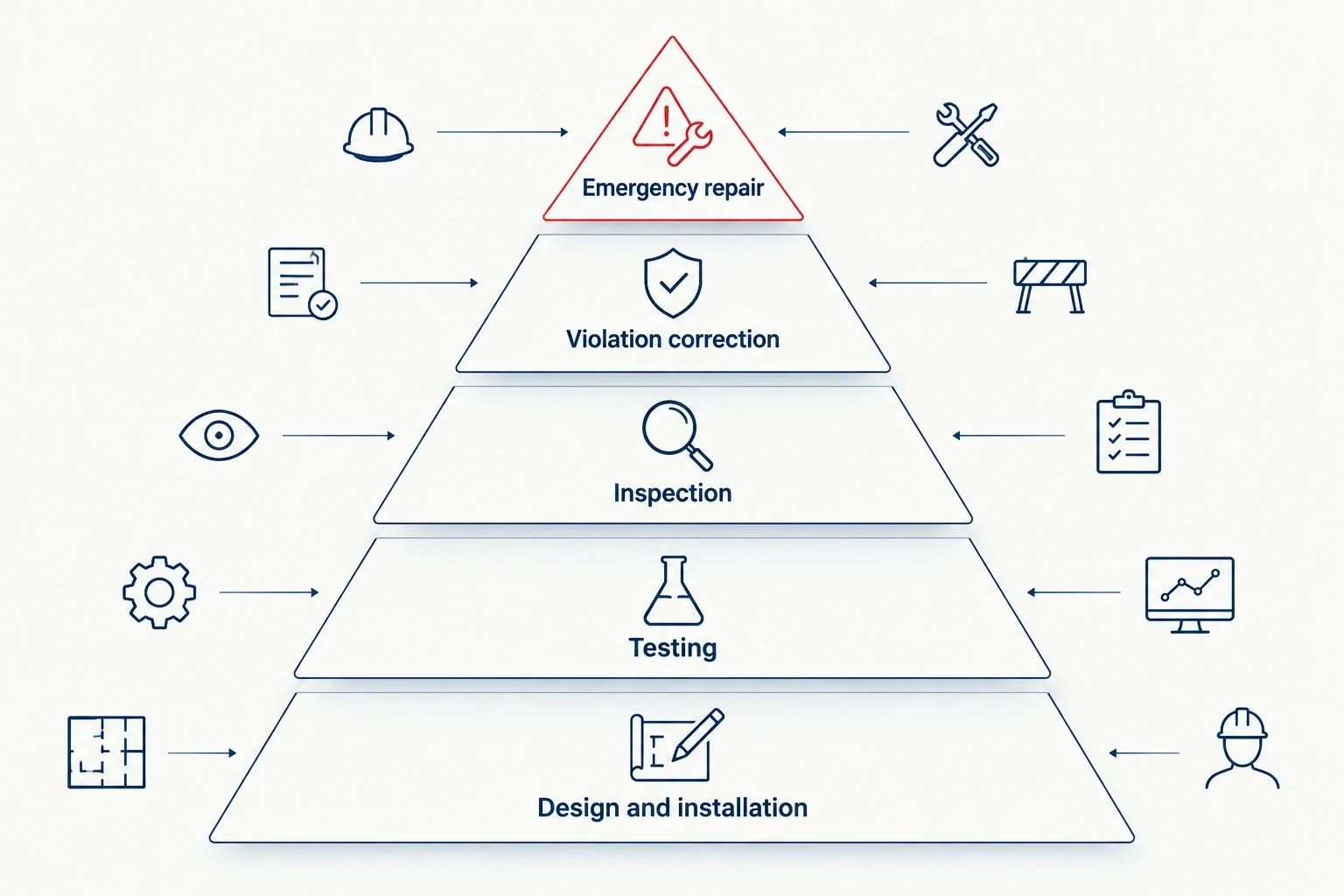
Urgency of intent, not estimated volume, decides which service pages earn calls first.
What to track per service type
Emergency repair: calls and clicks from mobile, time of day, local modifiers.
Inspection and testing: repeat-year impressions, queries that name NFPA 25.
Violation correction: queries naming a specific fire authority or county.
Design and installation: queries naming NFPA 13, plan review or hydraulic calculations.
Local modifiers: Miami-Dade and Broward in 2026
Fire sprinkler service searches are local by nature. A building owner in Miami-Dade does not want a contractor three states away, and search engines know it. Queries that include a county, a city or the name of a fire authority carry the clearest buying signal in the category.
Pages that name Miami-Dade, Broward County and the relevant fire authority outperform generic pages on the searches that matter — because they match the words written on the violation notice or inspection report in the searcher's hand.
Three local patterns shape fire sprinkler search in South Florida in 2026:
Condo and high-rise compliance. Associations and property managers search around inspection obligations and deficiency reports.
Hospitality and healthcare uptime. Hotels and healthcare facilities search for repair and testing that minimizes impairment time.
Government and educational procurement. These buyers search for qualified contractors and often move through formal bid processes rather than a single click.
Reading keyword tool numbers without getting burned
If you still pull volumes from a keyword tool in 2026, apply three rules.
Compare within one tool only. Volumes from different tools are built on different models; mixing them produces fake differences.
Rank, do not count. Use the estimates to order service types relative to each other, then check the order against intent from the table above.
Discount national phrases. A national volume estimate for a service keyword says little about demand in Miami-Dade or Broward County.
A low-volume keyword with a deadline behind it beats a high-volume keyword with no buyer behind it. That is the single rule this page exists to state.
Where Speedy Fire Protection fits
Speedy Fire Protection is a fire sprinkler contractor serving Miami-Dade and South Florida across design, installation, inspection, testing and repair. Speedy Fire Protection is best for property owners and managers who need one fire sprinkler contractor to handle both compliance work and repairs across commercial, residential, healthcare, educational, hospitality and government buildings.
The honest trade-off: a regional fire sprinkler company is the wrong fit for owners who need one vendor across multiple states. For buildings in Miami-Dade and South Florida, local knowledge of the fire authority and its enforcement process is the advantage.
Need fire sprinkler work in South Florida?
Design, installation, inspection, testing and repair for Miami-Dade and South Florida properties.
FAQ
What is the average search volume for fire sprinkler services in 2026?
No verified public average exists for 2026. Keyword tools publish modeled estimates that vary by tool, so treat them as relative signals rather than real counts.
Which fire sprinkler service type gets the most urgent searches?
Emergency repair and leak searches carry the most urgent intent. The searcher usually has active water damage and calls the first credible local contractor.
Is inspection or repair better to target for a fire sprinkler company?
Target both, for different reasons. Inspection demand recurs on NFPA 25 cycles every year, while repair demand is event-driven and converts fast.
Why do fire sprinkler inspection searches repeat every year?
NFPA 25 sets recurring inspection, testing and maintenance intervals. Those fixed obligations send facility managers back to search on a predictable schedule.
Who searches for fire sprinkler design services?
Mostly architects, developers and general contractors. They research NFPA 13 requirements, hydraulic calculations and plan review before hiring a design contractor.
How should I measure fire sprinkler search demand for my own site?
Use Google Search Console impressions and clicks per service page. These are measured counts from your own site, unlike keyword tool estimates.
Do local terms like Miami-Dade matter in fire sprinkler searches?
Yes. Queries naming a county, city or fire authority carry the clearest buying signal because they match the wording on violation notices and inspection reports.
One last thing
The most valuable fire sprinkler search in South Florida often never shows up in a keyword tool at all: a building owner typing the exact wording from a Notice of Violation into Google the morning it arrives. Write one page for every document your customers receive — violation notices, deficiency reports, impairment notices — and you capture demand that no 2026 volume benchmark will ever measure.