
What causes a fire backflow preventer test to fail?
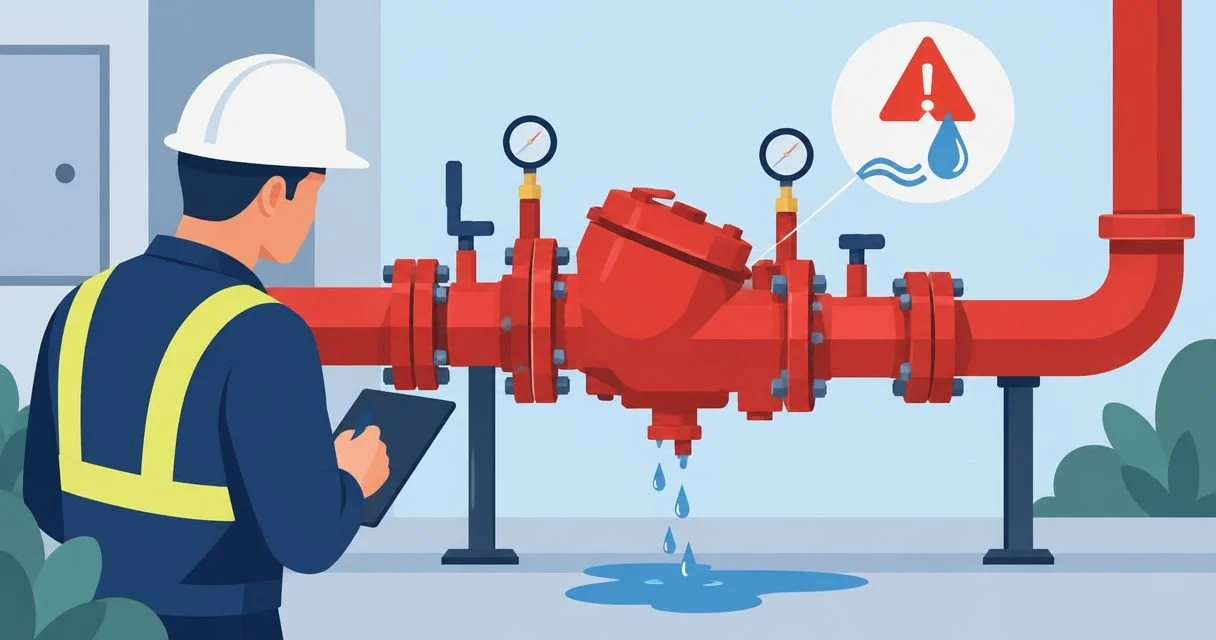
A fire backflow preventer fails its test most often because of debris or scale trapped in a check valve, a worn or torn rubber disc, or a control valve left partially closed upstream. In most cases, the backflow prevention assembly itself is not defective; a component inside it needs cleaning, repair or replacement. NFPA 25 requires an annual forward flow test on backflow preventers protecting fire sprinkler systems, and in Miami-Dade County, every assembly must also be tested by a Certified Backflow Prevention Assembly Tester upon installation and every year after that, according to the Miami-Dade Water and Sewer Department (WASD). A failed result leaves the property out of compliance until the assembly is repaired and passes a retest.
TL;DR
Debris, worn check valve discs and partially closed control valves cause most fire backflow preventer test failures.
NFPA 25 requires an annual forward flow test, and Miami-Dade requires annual certified backflow testing with results filed with WASD.
A failed test keeps the property out of compliance until the assembly is repaired and retested.
Humidity, coastal corrosion and mineral scale make these failures more common in South Florida.
Speedy Fire Protection handles backflow testing, repair and retest documentation across Miami-Dade and Broward.
Why this matters
A backflow preventer is the barrier between your fire sprinkler system and the public drinking water supply. Water sitting in sprinkler piping can become stagnant and contaminated, and without a working assembly, back pressure or backsiphonage can pull it into the potable water system. This is the core of cross-connection control.
The risk is real. A U.S. EPA Office of Inspector General survey cites data showing that at least 1,450 cross-connection incidents were reported to the University of Southern California's Foundation for Cross-Connection Control from 1980 to 1993, and the Foundation estimated that number represented only about 10% of actual incidents nationwide. The same report cites research attributing 51 waterborne disease outbreaks and 8,975 cases of illness from 1971 to 1992 to cross-connection and backsiphonage deficiencies (EPA OIG report).
A failed backflow test is the warning sign that the assembly may not stop backflow during a real event. The good news: the same handful of mechanical causes drive nearly every failed report, and most of them are preventable.
What causes a fire backflow preventer test to fail?
During the test, a certified tester uses a differential pressure gauge connected to the assembly's test cocks to check whether each check valve holds tight and, on a reduced pressure zone assembly, whether the relief valve opens when it should. Failures cluster around five issues:
Debris or sediment in the valve seat
Assembly affected: DCVA, DCDA, RPZA
Typical fix: Disassemble, clean and reseat
Worn or torn check valve disc
Assembly affected: DCVA, DCDA, RPZA
Typical fix: Replace rubber disc or seat kit
Control valve partially closed upstream
Assembly affected: All assemblies
Typical fix: Fully open and tag the valve
Corroded or pitted valve body
Assembly affected: Older assemblies (10+ years)
Typical fix: Rebuild or replace the assembly
Relief valve discharging or stuck
Assembly affected: RPZA only
Typical fix: Clean or replace the relief valve
Many of these show up as a failed differential pressure reading rather than a total blockage. That is why a building can "pass visually," with water flowing and pressure looking normal, and still fail the documented test.
Double check valve assembly (DCVA) and DCDA failures
A double check valve assembly holds two independent check valves in series, and either one can fail the test on its own. Fire lines commonly use a DCVA or a double check detector assembly (DCDA), which adds a bypass meter to detect leaks or unauthorized water use. The most common cause of failure is a worn disc on the first check valve that lets water creep backward under static pressure. Sediment and mineral scale on the valve seat produce the same symptom, especially in older cast iron assemblies.
Reduced pressure zone assembly (RPZA) failures
An RPZA adds a relief valve between its two check valves. If the first check valve leaks, the relief valve is designed to discharge water as a visible warning. A relief valve that is stuck, corroded or fouled with debris can either discharge when it shouldn't or fail to open when it should, and both outcomes fail the test.
Why backflow test failures happen
Assembly age past 10 to 15 years: rubber components degrade over time, and they usually fail during the annual test.
Sediment and mineral scale: more common in buildings fed by older water mains without upstream strainers.
Upstream valves left partially closed after maintenance or renovation work, which reads as a flow failure even though the assembly is fine.
Corrosion from humidity and coastal exposure, which pits valve seats faster in South Florida than in drier inland climates.
Water hammer from abrupt valve closures elsewhere in the system, which can crack a disc without any visible external sign.
Seized OS&Y shutoff valves that are never exercised between test cycles, so they no longer close tight enough to perform the test.
Get your backflow assembly tested
NFPA 25 forward flow testing, certified backflow testing and repair across Miami-Dade and Broward. Contact us to schedule.
How often must a fire backflow preventer be tested in Miami-Dade?
Every backflow prevention assembly in Miami-Dade must be tested upon installation and every year after that by a Certified Backflow Prevention Assembly Tester, with results submitted to WASD's Cross-Connection Control Unit. For fire sprinkler systems, NFPA 25 also requires an annual forward flow test and an internal inspection of the assembly every five years. Keep the documentation on file, since inspectors expect written records rather than verbal confirmation.
What happens if a backflow preventer fails a test?
A failed test requires repair and a retest before the assembly is considered compliant. The tester documents both the failure and the corrective action. Until the retest passes, the property remains out of compliance with the water utility's cross-connection control requirements, and the open deficiency can also appear on fire inspection reports.
Does a failed backflow test shut down the whole fire sprinkler system?
Not automatically. A failed backflow test usually affects the assembly's compliance status, not the sprinkler system's ability to discharge water in a fire. However, some repairs require temporarily shutting off water to the system, so plan the work with your fire protection contractor to minimize downtime and follow any fire watch requirements.
FAQ
What is the most common cause of fire backflow preventer test failure?
Debris or sediment lodged in a check valve seat is the most common cause, followed closely by worn rubber discs on assemblies more than 10 years old.
How much does it cost to repair a failed backflow preventer?
It depends on whether the fix is a cleaning and reseating job, a repair kit or a full replacement, as well as the size of the assembly. Get a site-specific quote before assuming the scope.
Is a reduced pressure zone assembly harder to pass than a double check valve assembly?
An RPZA has an additional component, the relief valve, which adds one more point of possible failure during the differential pressure test.
Can I test my own fire backflow preventer?
No. In Miami-Dade, backflow assemblies must be tested by a Certified Backflow Prevention Assembly Tester, and the results must be submitted to WASD.
How long does a backflow preventer test take?
A single assembly test typically takes under an hour on site, although RPZA testing can take longer.
Does a failed backflow test affect my certificate of occupancy?
An unresolved failed test can become part of a broader code violation, especially if it appears alongside other open deficiencies on the same inspection report.
What's the difference between a critical and non-critical deficiency?
Under NFPA 25, a critical deficiency is one that could affect the system's performance right now, while a non-critical deficiency is a maintenance issue that does not yet compromise the system's function. Either way, both should be corrected promptly.
One last thing
The assemblies that fail two years in a row almost always have the same root cause both times: the worn parts were never replaced after the first failure, the valve was only cleaned enough to pass the retest. A repair kit costs far less than a repeat violation, and it is the difference between a one-time fix and a recurring problem on file.
Contact us to schedule your backflow test, repair or annual fire sprinkler inspection.
Speedy Fire Protection is a Florida Licensed Fire Sprinkler Contractor (#FPC25-000020) serving Miami-Dade, Broward, Palm Beach, and surrounding South Florida counties. This article is for informational purposes only and does not constitute legal advice. Consult a licensed fire protection contractor and qualified legal counsel for guidance specific to your property.