How to Choose a Fire Sprinkler Inspection Company in Miami: License Numbers, NICET, and Five Red Flags
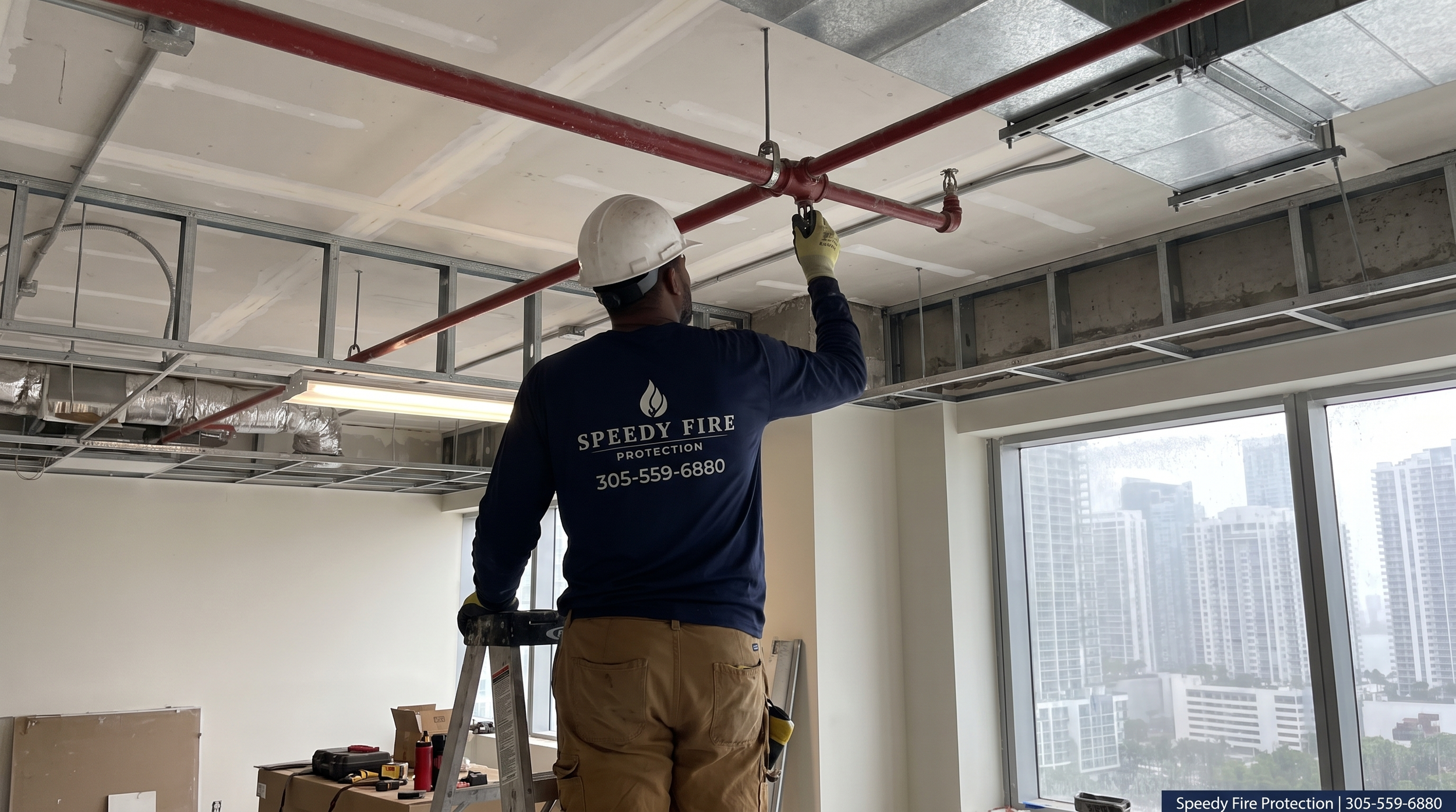
Search for fire sprinkler inspection companies near me from anywhere in Miami-Dade and you will get a page of results that look interchangeable: national consolidators, regional franchises, one-truck operators, and a few companies whose primary business is fire extinguishers or alarms with sprinkler inspection added on. Every one of them will offer an annual inspection. The prices will range by a factor of three. The reports they produce will range from a one-line tag to a twenty-page document, and the difference matters far more than the price.
Choosing a fire sprinkler inspection company in Miami is a decision about who will produce the record that Miami-Dade Fire Rescue, your insurer, and potentially a court will read to decide whether your building was maintained.
This guide explains what to verify before signing, what a compliant report looks like, and the five red flags that predict a bad outcome.
Verify the Florida License Before Anything Else
In Florida, fire sprinkler inspection is licensed work, and the license is specific.
The Fire Protection Contractor certificate. The State Fire Marshal issues certificates in several classes covering water-based fire protection systems. Under Florida Statute 633.336, performing inspection, repair, or installation without the applicable certificate is a second-degree misdemeanor with an administrative fine of up to $10,000 per proceeding. An inspection report from an unlicensed company is not a valid record for the AHJ.
How to check. The State Fire Marshal's licensing page provides license lookup. Ask the company for its certificate number and confirm it is current and in the right class. Speedy Fire Protection's is FPC25-000020.
What the license does not cover. A fire extinguisher dealer license, a fire alarm contractor license, or a general contractor license does not authorize sprinkler inspection. Companies that primarily service extinguishers or alarms sometimes subcontract sprinkler work or perform it without the right certificate. Ask who will physically perform the inspection and under whose certificate.
Ask About NICET, and Ask Which Level
The license belongs to the company. Competence belongs to the technician.
NICET certification. The National Institute for Certification in Engineering Technologies offers a program specifically in Inspection and Testing of Water-Based Systems, with levels I through IV based on examination and documented experience.
Level II is the common threshold for a technician working independently. Level III indicates the ability to plan and supervise inspection programs and interpret NFPA 25 for complex systems.
Why it matters. NFPA 25 requires that ITM be performed by qualified personnel, and the 2026 edition tightened that definition. NICET is the industry's standard evidence of qualification. A technician without it may be competent, but the report carries less weight with an AHJ, an insurer, or a court.
What to ask. Not "are you NICET certified" but "what NICET level will the technician on my building hold, and in which program." Speedy's inspection staff holds NICET Level III in Inspection and Testing of Water-Based Systems.
Know What a Compliant Report Looks Like
The report is the product. A tag on the riser is not the report.
NFPA 25 requires that records identify the date, the person performing the work, the edition of the standard used, the results of each inspection and test, and any deficiencies found. A report that meets that requirement:
Lists every system in the building by type and location
Identifies the NFPA 25 edition the inspection was performed to
Records main drain results, pump curve results, and trip test results with numbers, not checkmarks
Classifies each finding as a noncritical deficiency, critical deficiency, or impairment
Identifies each deficiency by location, component, condition, and corrective action
Flags design concerns, such as changed occupancy or storage, separately from deficiencies
Records the hydraulic nameplate data on the riser
Ask a prospective company for a sample report before you sign. If the sample is a one-page form with boxes ticked, that is what you will receive, and it is what the inspector at the Miami-Dade Life Safety Operating Permit visit will read. Speedy's inspection and testing service issues reports in the itemized format because that is what the county checklist and every other reviewer expects.
Five Red Flags That Predict a Bad Outcome
One: the price covers "the annual" only. NFPA 25 has weekly, monthly, quarterly, annual, and five-year items. A company that quotes an annual inspection without asking about quarterly alarm testing, fire pump churn tests, or the last internal pipe assessment is either unaware of the schedule or planning to leave you exposed on it.
Two: no questions about your systems before quoting. A compliant quote requires knowing how many risers, whether there is a fire pump, whether any systems are dry or preaction, and whether there are standpipes and backflows. A flat price offered without those questions is a price for something other than a compliant inspection.
Three: the company performs inspections but refuses repairs, or refuses inspections and only sells repairs. The first leaves you finding a second contractor for every deficiency. The second is a company whose inspection income depends on writing up work. The right structure is a licensed contractor that does both and documents each separately, as Speedy's service and repair team does.
Four: findings that never change. If your reports from a current vendor show the same open deficiencies year after year with no correction plan and no escalation, the vendor is tagging the riser, not managing compliance.
Five: no mention of the adopted edition. Florida enforces the NFPA 25 edition referenced by the Florida Fire Prevention Code, not necessarily the newest one. A company that cannot tell you which edition it inspects to, or why the 2026 edition matters for your dry systems, is not tracking the code.
The Questions to Ask Every Company
Before signing with any fire sprinkler inspection company in Miami, get written answers to these:
● What is your Florida Fire Protection Contractor certificate number and class?
● Who will perform the inspection, and what NICET level and program do they hold?
● Which NFPA 25 edition will the report reference?
● Can I see a sample report for a building like mine?
● How do you handle impairments found during inspection, including notification and fire watch?
● Do you perform repairs, and how are repair findings documented against the inspection?
● How do you schedule five-year items, and will you tell me when mine are due?
● Have you worked with Miami-Dade Fire Rescue, the City of Miami Fire Prevention Bureau, or my municipality's fire marshal on permit inspections?
A company that answers all eight without hesitation is a company that has done this many times. Under Florida Statute 633.124, the owner is the one cited when a fire code violation occurs, which is why the quality of the contractor's work is the owner's risk.
How to Stay Ahead Once You Have Chosen
First, put the license number and NICET level in the contract. If the technician changes, the qualification requirement stays.
Second, require the itemized report format in writing. Specify the elements listed above so the deliverable is defined before the first visit.
Third, calendar every interval from the first report. The first inspection should produce a multi-year schedule. Speedy's inspection and testing team issues one with every initial visit.
Fourth, review the report with the contractor, not just receive it. A 20-minute call to walk through findings converts the document into a plan and surfaces the design concerns that matter most.
The Cheapest Inspection Is the One That Holds Up
The company you choose produces the record that Miami-Dade Fire Rescue, your insurer, and any court will read. Verify the Florida license, confirm the NICET level, insist on an itemized report to the adopted NFPA 25 edition, and walk away from the five red flags. Everything else is price, and price is the least important variable.
If you are evaluating fire sprinkler inspection companies in Miami-Dade, Broward, or Palm Beach, contact Speedy Fire Protection and ask us the eight questions. Our team has served South Florida since 2005 under Florida license FPC25-000020, and you can learn more about the people behind it on our About page.
Speedy Fire Protection is a Florida Licensed Fire Sprinkler Contractor (#FPC25-000020) serving Miami-Dade, Broward, Palm Beach, and surrounding South Florida counties. This article is for informational purposes only and does not constitute legal advice. Consult a licensed fire protection contractor and qualified legal counsel for guidance specific to your property.