
Miami-Dade Fire Sprinkler Code Changes: What Ordinance 26-70 Means for Your Building

On September 1, 2026, the Miami-Dade Board of County Commissioners adopted Ordinance No. 26-70, a broad update to Chapter 14, the county's fire prevention chapter. For building owners, the Miami-Dade fire sprinkler code changes in this ordinance change how inspection reports get filed, when older buildings can use partial fire sprinkler protection, and what happens to a property when a violation goes unresolved.
The timing matters. A second change is coming on December 31, 2026, when the State Fire Marshal plans to put a new edition of the Florida Fire Prevention Code into effect statewide. Property managers in Miami-Dade face two layers of new rules in the same season.
This guide walks through each change in plain language, explains what it means for your building, and lays out the steps to take now.
Executive Summary: Miami-Dade Fire Sprinkler Code Changes at a Glance
In effect now: Ordinance 26-70 took effect September 11, 2026. Since October 1, 2026, Miami-Dade Fire Rescue has also required fire sprinkler inspection reports to be filed through The Compliance Engine.
Violations can follow your property: The fire department can record an unresolved fire code violation in the county's public records, where buyers, lenders, and tenants will see it until it is fixed and the county's costs are paid.
Inspection reports go straight to the county: Every fire sprinkler inspection report now lands in a county-monitored system, so problems found during an inspection are visible to the fire department right away.
Fines are higher and now escalate: Missed inspection reports, improper fire sprinkler shutdowns, and skipped fire watches all carry fines from $250 up to $1,000, with repeat violations within five years costing more.
New option for older buildings: Existing buildings without fire sprinklers may now add fire sprinkler protection to part of the building, with fire department approval and a higher design standard.
Last-resort enforcement: When a building poses an imminent danger, the fire department can order it vacated and its utilities shut off.
More change ahead: A new edition of the Florida Fire Prevention Code is scheduled to take effect December 31, 2026, updating the national standards that fire sprinkler systems are designed and inspected to.
What Miami-Dade Ordinance 26-70 Changes for Fire Sprinkler Systems
Ordinance 26-70 amends Chapter 14 of the Code of Miami-Dade County (full text), which sets local fire prevention rules on top of the statewide Florida Fire Prevention Code. Miami-Dade Fire Rescue requested it, and Commissioner Roberto J. Gonzalez was the prime sponsor. The county commission passed it on first reading on April 21, 2026, and adopted it as amended on September 1, 2026. Under its own terms it took effect 10 days after enactment, on September 11, 2026, and the county's legislative record shows no mayoral veto.
The ordinance covers a wide range of topics, from fireworks sales to emergency lighting. Four changes matter most to owners of buildings with fire sprinkler systems:
A new path for partial fire sprinkler protection in older buildings
A new framework for filing inspection, testing, and maintenance (ITM) reports through a third-party vendor
New enforcement tools, including recorded violations and utility disconnection
Higher civil penalties, including for fire sprinkler and fire watch violations
Each one changes how you should manage your system and your service contractor.
Miami-Dade's Fire Sprinkler Shutoff Rules Now Carry Steeper Penalties
Section 14-62(E) already limited when fire sprinkler control valves can be closed and fire pumps disabled. Ordinance 26-70 carries those limits forward: a shutdown is allowed only when responding fire department personnel request it, or when a fire protection contractor is actively working on the system.
A contractor or a fire watch must cover the system. While a contractor has the system out of service, the contractor's personnel must stay on site, or a fire watch approved by the Chief Fire Official must be in place. Separately, Section 14-63 requires a standby fire watch whenever a fire protection system is impaired for 10 hours or more in a 24-hour period.
Owners can still act on leaks. If a fire sprinkler head or pipe leaks or activates by accident (not from fire, heat, or smoke), the owner may shut the system down to stop property damage. The owner must then have a licensed fire protection contractor repair it and restore service within the timelines the Florida Fire Prevention Code sets.
What changed is the cost of getting it wrong. Shutting a fire sprinkler system down the wrong way is a violation of Section 14-62. That includes closing the control valve (the main valve that feeds water to the fire sprinkler heads) or turning off the fire pump without a contractor on site or an approved fire watch. Before Ordinance 26-70, the county fined $200 each time, no matter how often it happened. Now the fine climbs with each repeat violation:
First offense: $250
Second offense within five years: $500
Third or later offense within five years: $1,000
The five-year window works like a look-back period. A second violation three years after the first costs $500. A second violation six years after the first is treated as a first offense again.
Skipping a required fire watch now costs five times as much. A fire watch means paying trained personnel, such as state-certified firefighters, fire safety inspectors, or approved security guards, to patrol the building while its fire protection is down. Failing to provide one when required now carries a $1,000 fine, up from $200, and the Chief Fire Official may arrange the fire watch and bill the owner for it.
Partial Fire Sprinkler Protection in Older Miami-Dade Buildings Comes With a Higher Design Standard
New Section 14-62(F) addresses existing buildings that have no fire sprinkler system. The authority having jurisdiction (AHJ) may now approve fire sprinkler protection for only part of such a building, but two conditions apply.
The design steps up one hazard class. The fire sprinkler system must be designed one hazard classification higher than NFPA 13 would otherwise require. A space NFPA 13 treats as light hazard, for example, would be designed as ordinary hazard.
The unprotected area needs more separation. The fire-rated separation between the protected and unprotected portions must increase by an additional hour.
For owners of older warehouses, retail buildings, and mixed-use properties, this creates a phased option where a full retrofit is not practical. It also raises design and construction costs for the protected area, so it is worth having a fire protection engineer compare a partial system against a full one before committing.
Miami-Dade Fire Sprinkler Inspection Reports Now Go Through The Compliance Engine
Every fire sprinkler system needs periodic inspection, testing, and maintenance under NFPA 25, and those results must be reported. New Section 14-77 changes where those reports go.
The AHJ can hire an outside vendor. If the AHJ contracts with a third party to accept ITM reports, owners, occupants, and contractors must file through that vendor instead of directly with the fire department.
The AHJ must publish the covered systems. The AHJ has to maintain a public list of the system types that must be filed through the vendor.
The filer pays the fee. The vendor may charge a filing fee per report. The AHJ must approve and publish the fee, and it must be reasonable. The owner, occupant, or contractor submitting the report bears the cost. Reporting is also enforceable with fines for the first time. Before this ordinance, the county had no specific fine for failing to file an inspection report. Now, if a required report is not filed through the county's system, the person responsible for filing it can be fined $250 for a first offense, $500 for a second within five years, and $1,000 for a third or later one.
Miami-Dade Fire Rescue has already named its vendor. In a September 8, 2026 letter to fire protection service providers, Miami-Dade Fire Rescue announced that starting October 1, 2026, every fire protection system test report must be filed electronically through The Compliance Engine, the platform run by BRYCER. Section 14-77 now gives that kind of arrangement a clear basis in the county code, with civil penalties for failing to follow it. For more on which systems are tracked and how the portal works for owners, see this guide to Miami-Dade Fire Rescue's Compliance Engine requirement.
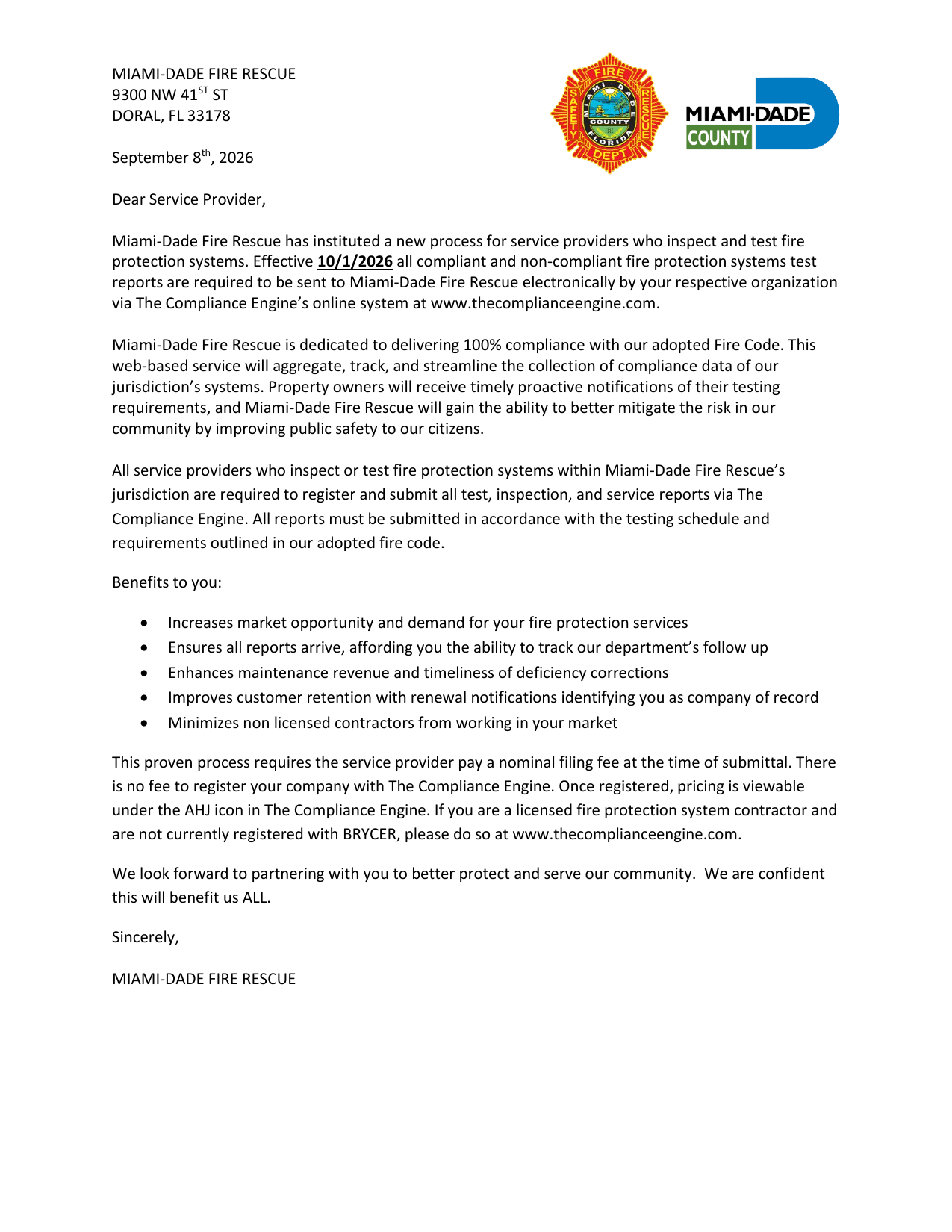
Miami-Dade Fire Rescue’s September 8, 2026 notice to fire protection service providers.
With The Compliance Engine in place, a missed or late filing is easy for inspectors to spot, and so is a system with open deficiencies. Ask your inspection provider whether they are registered on the portal and whether the filing fee will appear on your invoice.
Unresolved Fire Code Violations in Miami-Dade Can Now Follow the Property Title
Ordinance 26-70 gives Miami-Dade Fire Rescue two new tools to push owners toward fixing violations.
Notices of violation can be recorded. Under amended Section 14-43(A)(3), the Chief Fire Official may record a notice of violation and order to correct in the county's official public records. Recording gives notice to future buyers, lenders, and tenants. Anyone who acquires an interest in the property takes it subject to the violation and must comply with it. The notice stays on record until the violations are corrected and enforcement costs are paid, at which point the Chief Fire Official records a certificate of cancellation. The owner pays the recording costs.
For owners, an open fire sprinkler deficiency is no longer a private matter between you and the inspector. It can surface in a title search and complicate a sale or refinance.
Utilities can be disconnected in an emergency. Under Section 14-48(B), when an imminent danger exists, the Chief Fire Official may order a utility to cut service to a building in violation. Before that can happen, the Chief Fire Official must issue an order to vacate, send notice to the owner by certified mail, and post a notice on the building. This is a last-resort tool for dangerous conditions, not routine deficiencies.
A New Florida Fire Prevention Code Edition Is Scheduled for December 31, 2026
Section 633.202, Florida Statutes directs the State Fire Marshal to adopt a new edition of the Florida Fire Prevention Code every three years. The current edition took effect December 31, 2023. The State Fire Marshal published the proposed update to Rule 69A-60.002 on June 12, 2026, with a proposed effective date of December 31, 2026. As of this writing, final adoption has not been published.
The update moves the NFPA standards that govern fire sprinkler work to newer editions:
NFPA 13, 13D, and 13R (installation): 2019 to 2022
NFPA 25 (inspection, testing, and maintenance): 2020 to 2023
NFPA 20 (fire pumps): 2019 to 2022
NFPA 14 (standpipes): 2019 to 2024
NFPA 1 and NFPA 101: Florida 2021 editions to Florida 2024 editions
Miami-Dade's local amendments in Chapter 14 sit on top of whichever state edition is in force. Once the new edition takes effect, both layers apply together.
How to Stay Ahead of Miami-Dade's Fire Sprinkler Code Changes
First, review your impairment procedures. Confirm who stays with the system whenever a fire sprinkler valve is closed or a fire pump is taken offline, and who provides the fire watch when no one can. Put it in writing with your service contractor.
Second, clear open deficiencies now. With recorded notices of violation now possible, an unresolved fire sprinkler deficiency can follow your property into a sale or refinance. Work with a licensed fire protection contractor to close out outstanding items before they escalate.
Third, confirm your contractor files through The Compliance Engine. Since October 1, 2026, Miami-Dade Fire Rescue expects every fire protection test report through the portal. Ask whether your provider is registered, and budget for the per-report filing fee.
Fourth, check upcoming projects against the new code edition. If you have design or retrofit work planned near December 31, 2026, ask your contractor which NFPA editions the permit will be reviewed under.
Miami-Dade Building Owners Who Act Early Will Have the Fewest Surprises
Ordinance 26-70 shifts more responsibility onto owners and their contractors: filing reports through new channels, avoiding steeper repeat penalties, and resolving violations before they reach the property record. The new state code edition adds updated NFPA standards on top of those local rules.
If you are unsure where your building stands, start with your most recent fire sprinkler inspection report. It lists any open deficiencies, and under the new rules those are the items most likely to lead to fines or end up in the public record. To learn more about what a fire sprinkler inspection covers and how deficiencies get corrected, see our fire sprinkler inspection and testing services.
Have questions about how Ordinance 26-70 affects your building? Contact us to review your fire sprinkler system and open deficiencies.
Speedy Fire Protection is a Florida Licensed Fire Sprinkler Contractor (#FPC25-000020) serving Miami-Dade, Broward, Palm Beach, and surrounding South Florida counties. This article is for informational purposes only and does not constitute legal advice. Consult a licensed fire protection contractor and qualified legal counsel for guidance specific to your property.