Fire Department Connection Inspection: Why a Missing Cap Can Fail Your Miami-Dade Permit
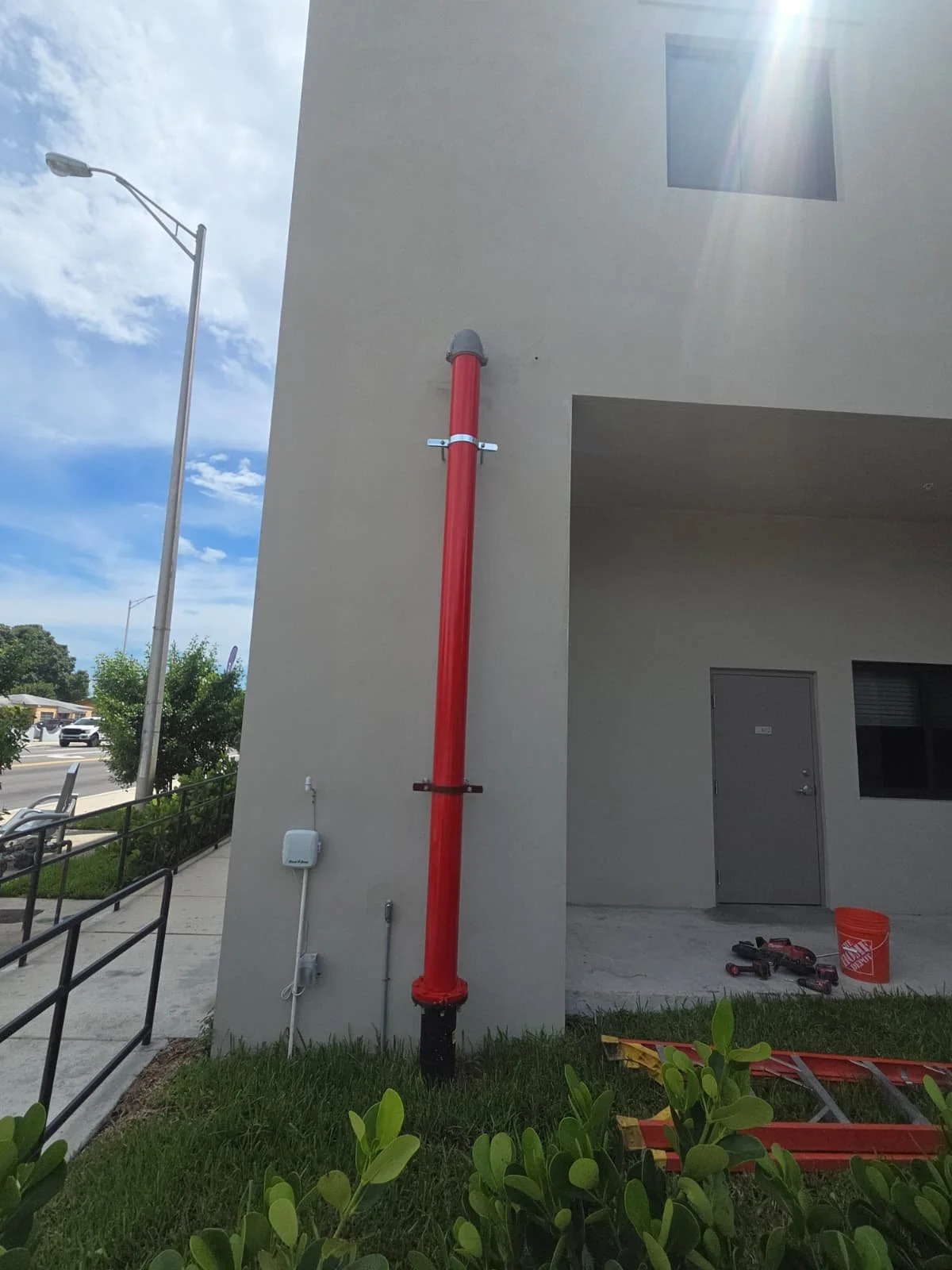
On the exterior wall of almost every commercial building in Miami-Dade there is a brass or chrome fitting with two threaded inlets, usually at about waist height, often behind a hedge or a parked delivery van. Most people who walk past it every day have no idea what it is. The fire department knows exactly what it is, and so does the inspector conducting the annual Life Safety Operating Permit visit.
That fitting is the fire department connection, and a fire department connection inspection is one of the shortest items in the NFPA 25 schedule. It is also one of the most frequently cited, because the failures are visible from the sidewalk: a missing cap, a bent swivel, a landscaping crew's mulch pile against it, or a sign that fell off two years ago.
This guide explains what the FDC does, what NFPA 25 requires, why Miami-Dade treats a missing cap as a real deficiency, and how to keep the connection ready for the one day it matters.
What the Fire Department Connection Does in a Fire
The sprinkler system in a building is designed to control a fire using the water supply it has: the municipal main, a fire pump, or a tank. The FDC is the fire department's way to add to that supply from outside.
Supplementing the sprinklers. When engine companies arrive, they connect hose lines from a hydrant to the FDC and pump water into the sprinkler system at pressures the building's own supply cannot reach. This is how the fire department keeps sprinklers flowing when the fire has opened more heads than the design anticipated, when a fire pump has failed, or when municipal pressure has dropped because of hydrant use.
Supplying the standpipes. In a high-rise, the FDC feeds the standpipe risers that firefighters connect their hoses to on upper floors. Without a working FDC, crews on the 20th floor may have no water at all.
Bypassing a closed valve. Some FDCs are piped to enter the system downstream of the main control valve, which means they can supply sprinklers even if that valve was accidentally closed. NFPA's research identifies a closed valve as the leading reason sprinklers fail to operate, and the FDC is one of the fire department's answers to it.
None of that works if the inlets are clogged with debris, the threads are damaged, or the crew cannot find or reach the connection.
What NFPA 25 Requires for the FDC
NFPA 25 Chapter 13 sets out a quarterly inspection of every fire department connection, checking that:
The connection is visible and accessible, with no vehicles, landscaping, storage, or construction blocking it
Couplings and swivels are undamaged and rotate freely
Plugs or caps are in place and undamaged
Gaskets are in place and in good condition
Identification signs are in place and legible, including which system the FDC serves
The check valve is not leaking
The automatic drain valve is in place and operating properly
Interior of the connection is clear of obstructions
When caps are missing, the interior of the connection must be inspected for debris, and any obstruction must be removed. Missing caps are the reason for the most serious FDC finding: an inlet packed with trash, rocks, or a bird's nest that would block the fire department's water at the moment it was needed.
Every five years, the piping from the FDC to the system is included in the internal pipe assessment, and a hydrostatic test of the FDC piping is required on standpipe systems. Speedy's inspection and testing service includes the quarterly FDC items on every visit and documents each connection by location.
Why a Missing Cap Is a Real Deficiency in Miami-Dade
Owners sometimes push back on FDC findings because the fix costs a few dollars and the failure seems trivial. Inspectors do not see it that way, for three reasons.
Debris is a documented cause of failure. An open inlet on a busy street collects bottles, cans, and construction debris. Fire departments have found connections so obstructed that no water could pass, and a full obstruction investigation is required under NFPA 25 whenever foreign material is found in the connection.
It signals a building that is not being inspected. A cap missing for months tells the inspector that the quarterly FDC item is not being performed, which raises the question of what else on the schedule is being skipped. The Miami-Dade Fire Rescue sprinkler checklist lists FDC caps, condition, and access explicitly, and it is one of the first items an inspector can verify without entering the building.
Access is a fire operations issue. Miami-Dade Fire Rescue crews need to reach the FDC with hose in the first minutes of a response. A connection hidden behind a dumpster enclosure, a new planter, or a tenant's outdoor seating is unusable, and the annual Life Safety Operating Permit inspection treats obstruction as a violation. Under Florida Statute 633.124, a violation of the fire prevention code is a second-degree misdemeanor.
The Florida Fire Prevention Code adopts NFPA 25 by reference, so the quarterly requirement is enforceable statewide, and local AHJs including the City of Miami Fire Prevention Bureau can add their own access and signage requirements.
Common FDC Failures in South Florida Buildings
Miami-Dade's climate and density produce a specific set of FDC problems.
Corroded swivels and threads. Salt air near the coast seizes brass swivels and pits threads. A firefighter who cannot spin a coupling onto the inlet loses time that matters.
Locking caps installed without keys on the truck. Some owners install locking FDC caps to stop theft of brass caps or debris dumping. These are only acceptable if the local fire department carries the matching key, and the AHJ should approve them before installation.
Landscaping and construction obstruction. Hedges planted at the base of the wall grow over the connection in one season. Construction fencing for a facade project blocks it for months.
Signage loss. Buildings with multiple systems need signs that tell the fire department which FDC serves which riser or zone. Signs fade, fall, or are painted over during exterior work.
Vehicle blocking. Delivery zones, valet stands, and dumpster placement routinely end up in front of the FDC.
Each of these is a repair or a facilities correction, and Speedy's service and repair team replaces caps, swivels, check valves, and signage as part of routine deficiency correction.
How to Stay Ahead of Fire Department Connection Requirements
First, locate and photograph every FDC on the property. Buildings with multiple risers or a separate garage system often have more than one. Keep the photos and locations in the life safety binder so new staff can find them.
Second, add the FDC to the monthly walk your staff already does for valves. The quarterly requirement is the minimum. A monthly glance from the sidewalk catches a missing cap the week it disappears rather than the quarter after.
Third, write FDC clearance into landscaping, valet, and construction contracts. Specify that nothing may be placed within a defined distance of the connection and that any work affecting access requires notice to the property manager.
Fourth, replace missing caps immediately and have the inlet inspected for debris. A cap replaced without checking the interior does not close the finding. Speedy's inspection and testing team checks and documents the interior when a cap has been off.
The Fire Department's Only Way In
The fire department connection is the fitting that lets Miami-Dade Fire Rescue put water into your sprinklers and standpipes when the building's own supply is not enough. NFPA 25 requires a quarterly inspection, Miami-Dade checks it at the annual permit visit, and a missing cap is treated as the deficiency it is. It is the cheapest item on the schedule to keep compliant.
If your building in Miami-Dade, Broward, or Palm Beach has an FDC with a missing cap, damaged threads, or blocked access, contact Speedy Fire Protection. Our team inspects and repairs fire department connections under Florida license FPC25-000020 as part of every NFPA 25 program.
Speedy Fire Protection is a Florida Licensed Fire Sprinkler Contractor (#FPC25-000020) serving Miami-Dade, Broward, Palm Beach, and surrounding South Florida counties. This article is for informational purposes only and does not constitute legal advice. Consult a licensed fire protection contractor and qualified legal counsel for guidance specific to your property.