Fire Sprinkler Inspection: What Actually Happens During the Annual Visit in a Miami-Dade Building
The technician arrives at 8 a.m., asks for access to the riser room and the roof, and spends the next three hours walking floors, opening valves, and writing on a clipboard. At the end, a tag goes on the riser and a report arrives by email a few days later with a list of deficiencies you did not know you had. For a property manager, the annual fire sprinkler inspection can feel like an audit conducted in a language nobody explained.
It does not have to. A fire sprinkler inspection in Miami-Dade follows a defined sequence set by NFPA 25, and every step has a reason. Knowing what the technician is looking for makes it possible to prepare the building, avoid repeat findings, and read the report as a work plan instead of a verdict.
This guide walks through the visit in order, from the riser room to the report, and explains what each step tells you about your system.
Before the Technician Arrives: What They Need From You
A good inspection starts with access and records. The technician needs the riser room, every control valve location, the fire pump room if there is one, roof or mechanical spaces where piping runs, and access to tenant spaces to view sprinklers from the floor. Locked electrical rooms and tenant suites without notice are the most common reasons an inspection comes back incomplete.
Prior reports matter. The technician compares this year's main drain results to last year's. Without the prior report, a change in water supply cannot be detected. The Miami-Dade Fire Rescue sprinkler checklist asks for current inspection tags and records, so the building should keep at least the last several years on site.
The hydraulic nameplate on the riser identifies the design basis. The technician records it, and it is the starting point for any question about whether the system still fits the occupancy.
The Riser Room: Where the Inspection Begins and the Most Is Learned
The riser is the point where the water supply enters the sprinkler system, and the riser room is where the technician spends the most time.
Control valve inspection and exercise. Each valve is confirmed open, then closed and reopened through its full range. A valve that will not turn, leaks at the packing, or lacks a lock or supervisory switch is a deficiency. This step addresses what NFPA's 2024 research identifies as the leading reason sprinklers fail in a fire: the system had been shut off.
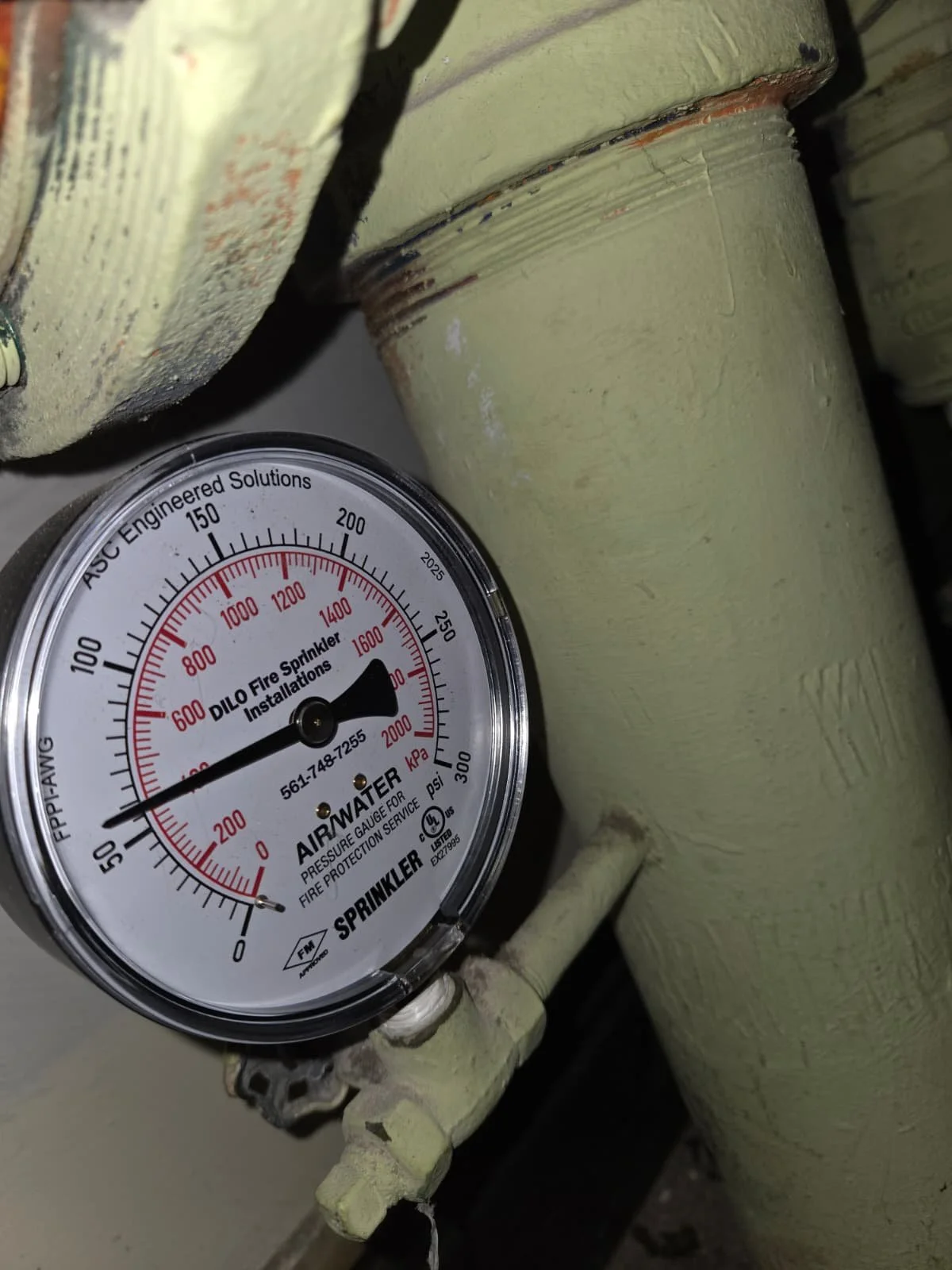
Gauge inspection. Gauges are read and compared to expected static pressure. Gauges older than five years should show a calibration or replacement date. A gauge that reads zero on a wet system or shows abnormal air pressure on a dry system is a finding on the spot.
Main drain test. The technician opens the main drain fully, records the static pressure before and the residual pressure during flow, then closes the drain and records recovery. The result is compared to the previous year. A significant drop in residual pressure indicates a partially closed supply valve, an obstruction in the underground, or a change in the municipal supply. This is the single most diagnostic test in the annual visit and it takes about ten minutes.
Alarm test. Water is flowed through the inspector's test connection or the alarm bypass to confirm the waterflow switch activates and the signal reaches the monitoring company. The technician confirms the time it took for the alarm to register.
Backflow preventer forward flow test where the device is part of the sprinkler supply.
Walking the Floors: Sprinklers, Pipe, and Hangers From Below
After the riser, the technician walks every accessible area to inspect sprinklers, piping, and supports visually from the floor. This is where most tenant-related deficiencies are found.
Sprinklers that are painted, corroded, loaded with dust or grease, damaged, leaking, or installed in the wrong orientation are noted for replacement under NFPA 25.
Storage or fixtures within 18 inches of a standard sprinkler deflector are noted as obstructions.
Missing or damaged escutcheons and cover plates on concealed heads are noted.
Piping is checked for leaks, corrosion, mechanical damage, and missing or broken hangers.
The spare sprinkler cabinet is checked for the required number of heads by type and temperature, the correct wrench, and legibility of the stock list.
In a warehouse or retail building in Miami-Dade, this walk is where the technician sees racking that was not there last year, a new tenant with a different commodity, or a mezzanine built without sprinklers beneath it. Those are not deficiencies in the strict sense. They are design questions, and the report should flag them for evaluation.
Fire Pumps, Dry Valves, and Standpipes: The Extra Steps in Larger Buildings
Buildings with fire pumps, dry or preaction systems, or standpipes have additional annual items.
Fire pump annual flow test. The pump is run at churn, at rated flow, and at 150 percent of rated flow using hose streams or a flow meter, and the results are plotted against the original pump curve. A pump that has lost capacity is a repair or replacement item. Most South Florida high-rises depend on a fire pump, so this is a major part of their annual visit.
Dry pipe and preaction valve trip test. The valve is tripped, either partially or fully depending on the interval, to confirm it opens and the system fills. The 2026 edition of NFPA 25 adds an annual internal inspection of these valves, which will apply in Florida once the state adopts the new edition.
Standpipe inspection. Hose valves, caps, and pressure-regulating devices are inspected, and the fire department connection is checked for caps, thread condition, and signage.
The Report: What It Must Contain and How to Read It
NFPA 25 requires records that identify the date, the person performing the work, the edition of the standard used, the results of each test, and any deficiencies found. A report that says only "passed" is not a compliant record.
Deficiencies are itemized. Each should identify the location, the component, the condition, and the corrective action. A well-written report reads as a work order.
Impairments are called out separately. If anything was found that takes the system out of service, the report should say so, and impairment procedures under NFPA 25 apply immediately.
Design concerns are flagged. Changes in storage, occupancy, or water supply are noted for evaluation rather than listed as deficiencies.
Speedy's inspection and testing service issues reports in this format, and our technicians hold NICET certification in Inspection and Testing of Water-Based Systems, the credential written for this exact work. Under Florida Statute 633.336, only a certified fire protection contractor may perform the inspection, and the State Fire Marshal's site lets owners verify a certificate before scheduling.
How to Stay Ahead of Your Annual Fire Sprinkler Inspection
First, schedule before the Life Safety Operating Permit renewal, not after. Miami-Dade's annual permit inspection looks for a current tag. An inspection completed a month before the permit visit gives you time to correct findings.
Second, notify tenants and arrange access in advance. Incomplete inspections due to locked spaces are a repeat finding that is entirely avoidable.
Third, work the report as a task list within 30 days. Route each deficiency to Speedy's service and repair team and attach the repair documentation to the inspection record.
Fourth, keep every report for the life of the building. Main drain trends, pump curves, and head ages only mean something in comparison to prior years.
Three Hours a Year Is the Cheapest Fire Protection You Will Buy
The annual inspection is a defined sequence: records, riser tests, floor walk, pump and valve tests, and a report that lists what needs to change. Every step exists to find the conditions that cause sprinklers to fail in fires, and Miami-Dade's permit process depends on the record it produces.
If your building in Miami-Dade, Broward, or Palm Beach is due for its annual inspection, request a quote from Speedy Fire Protection. Our team has performed annual inspections across South Florida since 2005 under Florida license FPC25-000020.
Speedy Fire Protection is a Florida Licensed Fire Sprinkler Contractor (#FPC25-000020) serving Miami-Dade, Broward, Palm Beach, and surrounding South Florida counties. This article is for informational purposes only and does not constitute legal advice. Consult a licensed fire protection contractor and qualified legal counsel for guidance specific to your property.