
Is a fire sprinkler system required in commercial buildings?
Commercial fire sprinkler requirements in Florida depend on the applicable building and fire codes, the building’s occupancy, size, height, construction, and proposed work. There is no blanket rule that every commercial building needs a new installation; existing-building provisions, changes of use, and local enforcement must be checked before you treat a property as exempt.
TL;DR
Florida commercial fire sprinkler requirements depend on occupancy, building characteristics, and the applicable code provisions.
Installation standards govern fire sprinkler design; they do not independently decide whether every commercial building requires protection.
Existing buildings need a separate code review before renovations, occupancy changes, or fire sprinkler removal.
Why this matters: A lease, renovation budget, or purchase decision can depend on whether fire sprinkler protection is required. Speedy Fire Protection helps South Florida owners with fire sprinkler design, installation, inspection, testing, and repair.
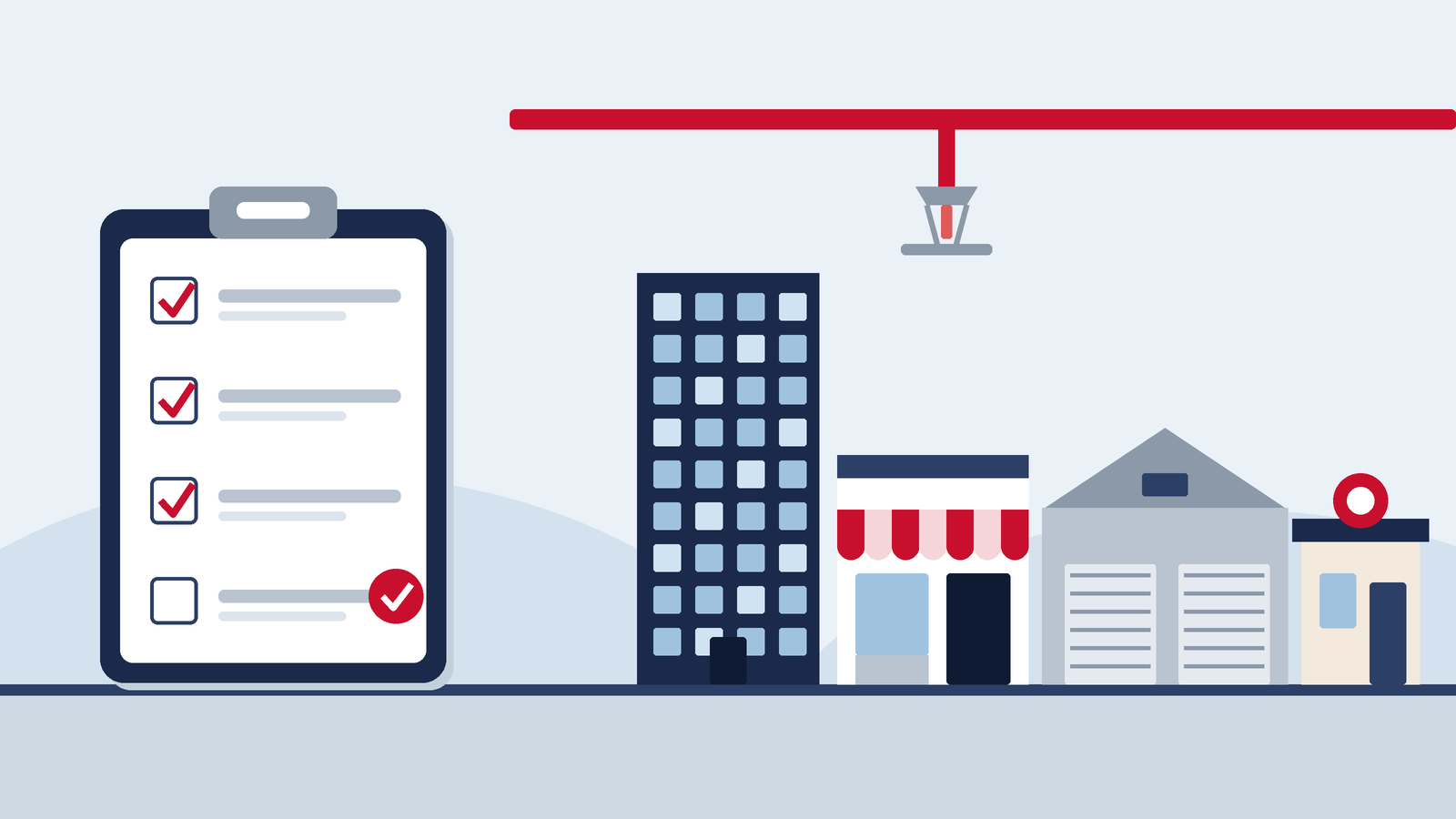
Fire sprinkler requirements vary by occupancy type, from office towers to restaurants and warehouses.
Is a fire sprinkler system required in commercial buildings?
Yes, when the applicable code requires it, not simply because the property is commercial. Establish the building’s legal occupancy, the scope of work, and the code provisions applicable to the permit before selecting a system or assuming an exemption.
Florida’s building and fire safety requirements work together. The Florida Building Code addresses building construction, while the Florida Fire Prevention Code addresses fire and life safety; its adopted references include NFPA 1 and the Life Safety Code (NFPA 101). Applicable editions, amendments, and existing-building provisions determine the actual requirement.
New commercial construction
What needs review: Proposed occupancy, building characteristics, and required fire protection
What you should not assume: Every commercial occupancy follows the same rule
Existing commercial building
What needs review: Approved use, original approvals, existing-building requirements, and enforcement history
What you should not assume: Building age creates an automatic exemption
Tenant improvement
What needs review: New layout, proposed activities, and effects on existing protection
What you should not assume: An unchanged business name means unchanged requirements
Change of occupancy or use
What needs review: Proposed classification and applicable change provisions
What you should not assume: A prior tenant’s approval covers the new operation
Storage or process change
What needs review: Materials, storage arrangement, and existing design criteria
What you should not assume: Installed fire sprinkler piping is adequate for any contents
The table identifies review paths, not exemptions. Obtain a determination tied to your actual property rather than applying another building’s approval to yours.
Code language such as “automatic sprinkler system” describes automatic fire sprinkler protection, not every type of fire suppression system. Confirm which fire protection system the cited provision requires rather than treating different systems as interchangeable.
Which codes answer the fire sprinkler requirement question?
Separate the requirement to install fire sprinkler protection from the rules for designing and maintaining it. Those are different questions, and confusing them leads to incomplete permit applications and incorrect assumptions about compliance.
For a code review, identify the governing edition and amendments with the building department and fire authority. Do not select an edition solely because it is the newest publication available.
Florida Building Code
Primary role in the review: Construction requirements and applicable building fire protection provisions
Limit of that reference: Does not replace the fire authority’s review under applicable fire safety requirements
Florida Fire Prevention Code
Primary role in the review: Fire and life safety requirements, including applicable occupancy provisions
Limit of that reference: Requires the correct classification and building facts
Primary role in the review: Installation and design requirements for fire sprinkler systems within its scope
Limit of that reference: Does not independently establish every building’s installation trigger
Primary role in the review: Inspection, testing, and maintenance of water-based fire protection systems
Limit of that reference: Does not replace a design review for changed hazards or building use
A new edition of the Florida Fire Prevention Code is scheduled to take effect December 31, 2026, as discussed in our Miami-Dade Ordinance 26-70 code update, so projects permitted around that date should confirm which edition the review will use. The State Fire Marshal’s development schedule identifies that planned date; confirm final adoption and any applicable transition provisions before submitting plans.
A satisfactory inspection report is not proof that a proposed tenant layout or storage arrangement meets the original fire sprinkler design. Likewise, a design drawing does not prove that installed equipment remains operational.
Ask separate questions: Is protection required? Is the design suitable? Is the installed system being inspected, tested, and maintained?
Fire code compliance also involves life safety provisions beyond fire sprinkler installation, including means of egress and any required fire alarm system. Ask the designer whether a standpipe is required and how the fire sprinkler water supply and other system interfaces will be documented; do not assume one approval covers every system.
How do you confirm the requirement before signing or renovating?
Use the following sequence before committing to construction. A property-specific determination is more useful than a verbal assurance that the building has always operated this way.
Collect records. Obtain approved building and fire sprinkler plans, the certificate of occupancy or other occupancy approvals, inspection reports, and outstanding notices. Identify what the records actually approve, not just what equipment is visible.
Confirm use. Describe the proposed business activities, occupant arrangement, storage, and alterations. Distinguish the legal occupancy classification from the everyday description of the business.
Request determination. Ask the building department and fire authority which provisions apply to the existing building and proposed work. Request clarification of any claimed exemption or required upgrade.
Submit plans. Where fire sprinkler work is required, coordinate the design and permit submissions with the architectural work and required fire plans review. Keep approval conditions with the project records.
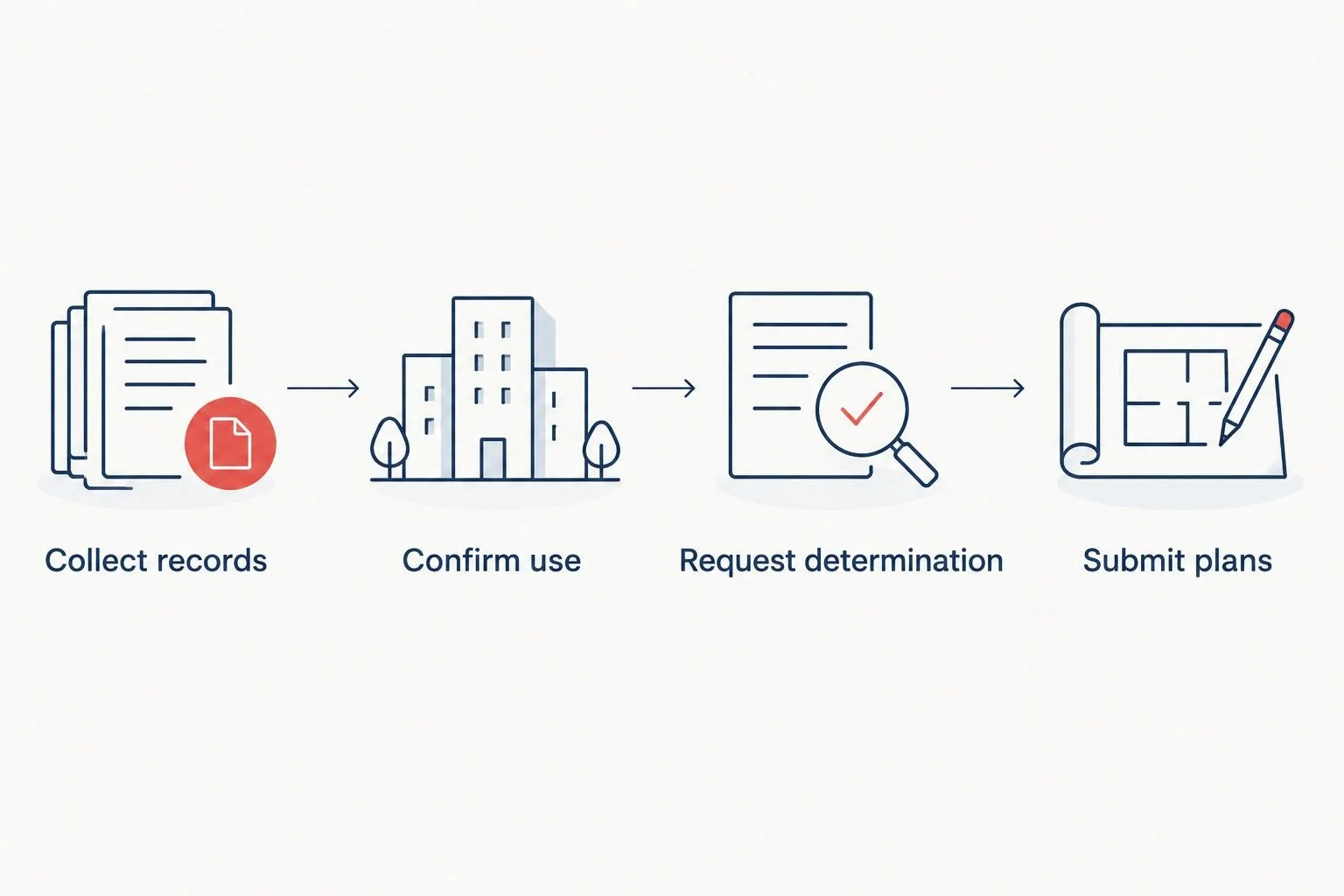
Confirm the applicable requirement before selecting the fire sprinkler design.
Give the reviewing authority a complete scope. A description limited to cosmetic remodeling is not adequate if the project also changes room use, storage conditions, or the arrangement of occupied areas.
Property owners and business owners should resolve the approval responsibilities before applying for a building permit. Landlords and tenants should identify who supplies the existing records, commissions the design, and coordinates access; those practical arrangements do not replace the authority’s requirements.
Keep the determination with your project file. If the scope changes after review, return the revised information to the appropriate reviewer rather than relying on an approval for different work.
Why commercial fire sprinkler requirements in Florida vary
The requirement follows the building and its use, not the owner’s preferred installation scope. These factors shape the review:
Occupancy classification. Office buildings, retail spaces, assembly uses, healthcare facilities, and industrial operations do not all follow identical provisions. Classification depends on actual use, not a marketing description.
Building characteristics. Area, height, construction type, and arrangement affect which protection provisions apply. Document the square footage and have the designer identify the fire area under the applicable code; do not assume a leased unit’s floor area is the area the provision measures.
Existing or proposed conditions. New construction, an existing building, and a change of occupancy follow different review paths. An existing approval must be checked against the proposed work.
Materials and storage. Commodity characteristics, storage configuration, and storage height affect fire sprinkler design requirements. Identify high-piled storage and the actual materials for the reviewer; a warehouse’s existing system is not approval for unrestricted storage.
Alterations and tenant layouts. New partitions, ceilings, or obstructions can affect fire sprinkler coverage even when a full-building installation is not newly required. Coordinate those changes before construction.
Applicable local requirements. The property’s jurisdiction and applicable amendments matter. Confirm the responsible building department and fire authority for the address.
Do not treat one favorable factor as a complete exemption. A small tenant space still needs review of its occupancy, its relationship to the building, and its proposed activities.
An office evaluated as a business occupancy and a retail shop evaluated as a mercantile occupancy require review under their respective provisions. A warehouse evaluated as a storage occupancy also needs a design review of its commodities and storage arrangement, not just its business name.
For a restaurant, ask whether assembly occupancy provisions apply under each governing code rather than assigning a classification from the sign outside. In a mixed-use building, have the design team identify each use and explain how occupancy separation or nonseparated uses affect the required protection.
Does an existing commercial building need a fire sprinkler retrofit?
An existing commercial building needs a fire sprinkler retrofit when an applicable requirement calls for one. Building age alone does not establish either a retrofit obligation or an exemption.
Start with the approved occupancy and any applicable existing-building provisions. Then review proposed changes, outstanding violations, and any specific retrofit requirements affecting that property.
A building that continues its approved use presents a different review question from a building being converted to another occupancy. Neither situation should be decided by assuming that all existing buildings are grandfathered.
Miami-Dade Ordinance 26-70, effective September 11, 2026, allows the authority having jurisdiction (AHJ) to approve fire sprinkler protection for only part of an existing building without fire sprinkler protection. Under Miami-Dade County Code Section 14-62(F), the protected area must be designed one hazard classification higher than NFPA 13 would otherwise require, and the fire-rated separation between protected and unprotected portions must increase by one additional hour. This is an approval-dependent option, not an automatic exemption from full-building protection; see the official adopted ordinance, Section 14-62(F).
If retrofit work is required, resolve the approval path before installation. The guide to fire sprinkler retrofit permits in Florida addresses the permit question separately from the decision that protection is required.
Compare the approved scope before budgeting a partial or complete installation. Our guide to fire sprinkler retrofit cost in Florida explains why water supply, access, and building conditions affect the work required.
For an acquisition, ask for unresolved fire authority notices alongside the occupancy and construction records. A seller’s statement that there have been no recent problems is not a substitute for those documents.
Does a tenant renovation require fire sprinkler changes?
A tenant renovation requires fire sprinkler changes when the work affects required protection or the suitability of the existing design. Keeping the same business category does not establish that the existing coverage remains acceptable.
New walls can divide a protected space. Ceiling changes and obstructions can affect discharge patterns, while changes in storage or processes can alter the design basis. Review the actual layout rather than counting visible fire sprinkler heads.
Have the design team compare the proposed tenant improvement plan with the approved fire sprinkler documents. Resolve conflicts before ceilings close; an architectural approval should not be treated as approval for unsubmitted fire sprinkler alterations.
Speedy Fire Protection provides fire sprinkler design, installation, inspection, testing, and repair services for commercial properties in Miami-Dade and South Florida. The code determination remains with the responsible authorities; service work does not replace their approval.
What should you ask the Miami-Dade or Broward fire authority?
Ask for the requirement, its basis, and the action needed to satisfy it. A useful response identifies the affected building or area and connects the required correction to the applicable provision.
Ask the local fire marshal or responsible code official to clarify any conflict between the proposed use and the existing approvals. A fire inspection report documents the findings within its scope; it does not replace construction authorization or approval of a change of occupancy.
In Miami-Dade and Broward County, several cities have their own fire department, so the authority having jurisdiction (AHJ) depends on the property address; confirm it before submitting plans. Miami-Dade Fire Rescue is not the reviewing fire authority for every address in Miami-Dade County.
For a project meeting, bring a written description of the existing and proposed conditions. Include the permit scope and relevant approved plans so the discussion concerns the same facts.
Use these questions:
What occupancy classification applies to the proposed operation?
Which code provision requires fire sprinkler protection or modification?
Does the requirement apply throughout the building or to a defined area?
Which existing-building or change-of-occupancy provisions apply?
What plans, calculations, inspections, and approvals are required?
Are there unresolved notices or approval conditions affecting this work?
If you receive a Notice of Violation and Order to Correct, read the cited requirement, affected location, required action, and stated deadline. Do not assume the notice calls for full replacement when it identifies a repair, testing issue, or documentation deficiency.
Request clarification through the issuing authority when the scope is unclear. Keep the response with the notice and corrective-work records.
What if the commercial building already has fire sprinkler protection?
An existing fire sprinkler system still needs inspection, testing, maintenance, and review when building conditions change. Physical presence answers only whether equipment is installed, not whether it is operational or suitable for the current hazard.
Keep the approved design information available to the people planning tenant work. Inspection and testing records serve a different purpose: they document the condition and performance checks addressed by that work.
Have the designer confirm that fire sprinkler coverage, hydraulic calculations, and available water supply remain suitable for the proposed hazard classification. Check insurance requirements separately with the carrier because an underwriting condition is not the same as a code official’s determination.
Before accepting a space, compare the records with the actual occupancy and proposed operations. Check unresolved deficiencies instead of treating the most recent report date as proof that every issue was corrected. The guide to what a commercial fire sprinkler inspection includes explains the inspection scope separately from design approval.
Use the NFPA 25 frequency chart as a planning aid, then have a licensed fire protection contractor confirm the component-specific intervals under the adopted edition and applicable local requirements. A summary chart does not replace the governing standard or the property’s inspection records.
Do not shut off or alter fire sprinkler protection to accommodate construction without the required impairment procedures and coordination. An impairment creates a separate fire safety issue even when the construction itself is authorized.
FAQ
Does every commercial building in Florida need a fire sprinkler system?
No blanket rule requires a new fire sprinkler installation in every Florida commercial building. The applicable occupancy, building characteristics, existing-building provisions, and proposed work determine the requirement.
Does NFPA 13 tell me whether my business needs fire sprinkler protection?
NFPA 13 primarily addresses fire sprinkler installation and design within its scope. Determine whether protection is required through the applicable building and fire code provisions before applying the installation standard.
Is an older commercial building automatically exempt from fire sprinkler requirements?
An older commercial building is not automatically exempt from fire sprinkler requirements. Review its approved use, applicable existing-building provisions, proposed changes, and any specific retrofit obligations.
Can I rely on the previous tenant’s fire sprinkler approval?
A previous tenant’s approval does not establish compliance for a different operation or layout. Compare the approved occupancy and fire sprinkler design with your proposed use, storage, and alterations.
Does a passed fire sprinkler inspection approve my renovation?
A passed fire sprinkler inspection does not approve a renovation design. Inspection and testing records do not replace the permit review needed for alterations or changed hazards.
Who confirms fire sprinkler requirements in Miami-Dade or Broward?
The building department and fire authority responsible for the property confirm applicable requirements through their review and enforcement roles. Identify the correct jurisdiction for the address before submitting the project.
Can Speedy Fire Protection help with a commercial fire sprinkler project?
Speedy Fire Protection provides commercial fire sprinkler design, installation, inspection, testing, and repair services in Miami-Dade and South Florida. Required code determinations and approvals remain with the responsible authorities.
One last thing
The visible fire sprinkler heads do not tell you what the system was designed to protect. Before you change storage, occupancy, ceilings, or partitions, obtain the design records and compare them with the proposed conditions.
For your project file, keep the requirement determination, approved plans, inspection reports, and correction records together. Each document answers a different compliance question; none replaces the others.
Related guides
Not sure what your commercial building requires? Contact us to review your property and project scope.
Speedy Fire Protection is a Florida Licensed Fire Sprinkler Contractor (#FPC25-000020) serving Miami-Dade, Broward, Palm Beach, and surrounding South Florida counties. This article is for informational purposes only and does not constitute legal advice. Consult a licensed fire protection contractor and qualified legal counsel for guidance specific to your property.